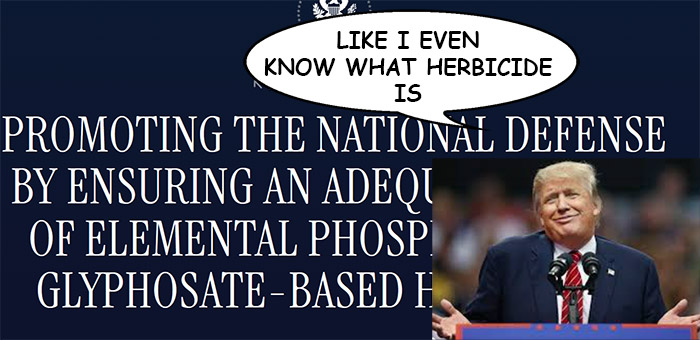
This week a presidential executive order declared the herbicide glyphosate “crucial to the national security and defense” because it allows “farmers and ranchers to maintain high yields and low production costs while ensuring that healthy, affordable food options remain within reach for all American families.”
Stop. Before we go on let’s be clear that the leading use of glyphosate is on soybeans which, until Trump’s ill-fated flurry of trade wars, were mainly exported to China to feed pigs. The other top uses are on field corn, the top use of which is for ethanol, and on cotton, which you can’t eat unless you are an insect. And you don’t actually need glyphosate at all; using best practices, organic crops average out to only 13% less productive than conventional — which is more of a feature than a bug considering how much we taxpayers spend paying farmers to reduce production (most recently with rice). Anyway:
This executive order invokes the Defense Production Act to shield glyphosate manufacturers from lawsuits. The DPA says that if a company is complying with a government order to produce something for national defense, it is immune.
This is the emergency parachute for Monsanto et al. after the main chute failed to open. But first let me explain how we got here.
Monsanto as Piñata
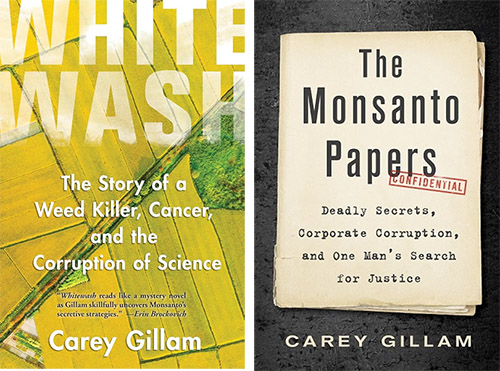
As you probably know, glyphosate has long been the ingredient in Monsanto’s Roundup, for decades the world’s best selling herbicide. It has been joined at the hip to Monsanto’s GM crops; about 90% of the world’s GM crop plantings have an herbicide tolerance trait, and glyphosate spraying has increased 15-fold since these crops spread in the 1990s.
For years glyphosate was thought to be generally safe to environment and human health, or certainly safer than most other powerful herbicides. But it often takes a long time for evidence of harm to emerge — a dramatic example being the 62 years it took to find that DDT was a powerful latency carcinogen. The vast majority of safety studies are short-term studies on rats, and the main research paper behind regulatory treatment of glyphosate was recently retracted — it was partly ghost-written by Monsanto and it ignored “long-term chronic toxicity and carcinogenicity studies” (here’s more on this from Marion Nestle).
By 2015 enough evidence had accumulated that the United Nations’ cancer agency (the IARC) classified glyphosate as genotoxic (damaging to human DNA) and “probably carcinogenic to humans” especially regarding non-Hodgkin lymphoma.
Monsanto launched a vicious campaign (often waged by its propaganda arms like Genetic Literacy Project) against the IARC including personal attacks on its scientists; internal documents reveal schemes to “orchestrate outcry” and “outrage”.
Still…cue a flood of lawsuits, which Monsanto started losing in 2018. (This was just 2 months after the German conglomerate Bayer bought Monsanto. If you’d shorted Bayer stock in 2017 you’d be eating biryani today, as is plummeted from $35 to $5.)
Bayer promptly flushed “Monsanto” as a brand, but with thousands of lawsuits still pending, “Monsanto Company” had to live on as an entity to be sued. Basically a legal piñata.
In 2023 Bayer replaced glyphosate in the lawn & garden Roundup, but not in the agricultural and professional versions. This was a sly move: Roundup was known as a delivery vehicle for glyphosate and was the world’s best-selling herbicide as such. Now the brand lives on with many consumers not even realizing it’s a completely different product, with a new gang of ingredients (“fluazifop-p-butyl, triclopyr TEA salt, diquat dibromide and imazapic ammonium”) that are hard to pronounce or remember. (Fluazifop-p-butyl, for instance, is an aryloxyphenoxypropionate herbicide lol.)
The new ingredients are also less studied so less evidence has accumulated on their health effects — although enough is known about diquat for it to be banned in the EU.
Bailing Out an Herbicide
My book The Agricultural Dilemma shows how industrial agriculture has essentially been a long-running clusterfuck between input industries and a package of vested interests within the government. here’s why:
It chronically and expensively overproduces, but is tarted up as technology needed to feed growing populations. It is called efficient but what it’s efficient at is benefiting those input industries at the expense of the public and the environment. Government likes food to seem cheap (and politicians like to be greased), so it subsidizes industrial agricultural technologies (undermining more sustainable approaches) and allows the makers and users of those technologies to externalize their costs. So that food that isn’t cheap at all in the long run.
Which helps explain why last year the US Congress agreed to concoct a free pass for glyphosate. This was supposed to be their parachute. It did this with a wonderfully sneaky little rider attached to an Interior & Environment Appropriations Bill, saying that government agencies could not issue warnings or product labels that differed from the most recent EPA risk assessments. Seems pretty innocuous right? Maybe even common sensical? Except that
‣ lawsuits often cite “failure to warn” claims meaning that companies should have warned users of dangers, and
‣ the most recent EPA assessment predated the scientific findings on glyphosate’s toxicity, and
‣ warning labels have to be approved by the EPA.
Get it? You can’t sue a company for failing to warn you about glyphosate’s health risks because the company isn’t allowed to warn you. And note that in the 11 years since the IARC determination of glyphosate’s likely carcinogenicity and genotoxicity, many scientific studies have found new evidence of non-Hodgkin lymphoma as well as leukemia, liver toxicity, kidney disruption, and
insulin resistance.
Industrial ag companies were for it — see the trade/propaganda group formed to lobby for protection. (Their website stresses the “clear science” on glyphosate’s safety.)
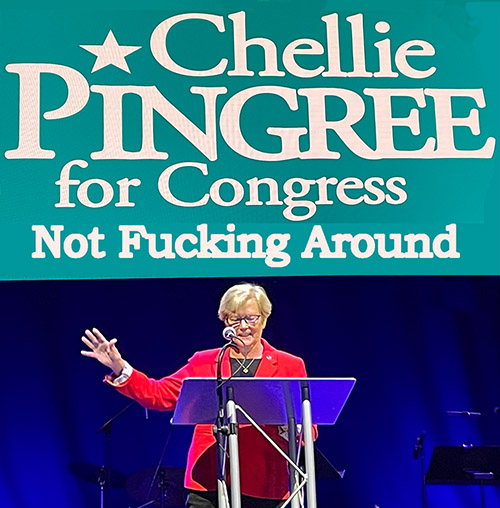
The trial lawyers association was not. But neither was cool Maine Congresswoman Chellie Pingree, who saw the rider as a ploy to keep scientific information from consumers and immunize the chemical industry from responsibility. She got the rider stripped from the bill last month.
But the ball was handed off to the executive branch.
Strapping on the Feedbag
The obvious question is — once the herbicide industry’s caterwauling got to the executive branch, what happened to our deranged window-pounding junkie of a Health & Human Services Secretary? RFK is supposed to be getting rid of processed foods and pesticides. He even brought one of the glyphosate lawsuits himself. And now his MAHA Moms have their panties in an unbelievable bunch over this betrayal.
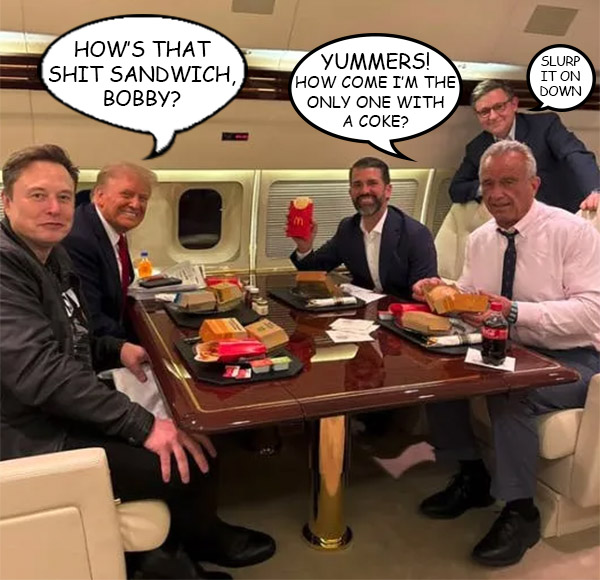
I doubt Trump cares very much. The only thing Trump has ever been right about is his understanding that RFK is a cheeseburger short of a Happy Meal. And he’s easily owned by actually making him eat a happy meal. So after he traded in his snorting cocaine off the toilet seat ways, Trump had him strap on the shit-filled feedbag.
And he’s still chowing down. He got dessert (or his just deserts) yesterday when Trump made him defend the order.
This executive order is farcical on many levels and there are already moves to override it in Congress. It is also highly challengeable in court. So stay tuned.
 fieldquestions
Yet another outrage in a long, long list. 2028 can’t come soon enough…
Realistically, how carcinogenic do you think glyphosate is?
Well the science is clear that to some degree it raises your chances of non-Hodgkin lymphoma (not to mention numerous other maladies), and we can be sure that it climbs with heavy exposure. I don’t think it’s possible to name that degree with much precision, but remember that these numbers are never sky high; even regular cigarette smokers only have a lung cancer rate around 10-20% higher than nonsmokers. And of course some people never use glyphosate and still die of non-Hodgkin lymphoma; my dad did.
But you have to be able to hold a company accountable for selling a product for common use with these health dangers without providing warnings, and even ghost-writing “scientific” studies that cover up the dangers. Not to mention orchestrating attacks on the scientists who study those dangers and evaluate them for the public.
Bayer has threatened to completely stop selling glyphosate in the US if they keep getting sued. What then?
We could all breathe a little easier. But we wouldn’t do without. As the blog said, organic crops are only slightly less productive than conventional — especially corn and soy, which take the most glyphosate. The organic:conventional yield ratios are around .84 for corn and .86 for soy (Seufert 2012). Given the crippling direct and indirect costs of overproduction, a 15% drop in production would be great, but that’s wishful thinking.
Seufert, V. et al. 2012. “Comparing the yields of organic and conventional agriculture.” Nature 485 (7397):229-232.
To be fair, if glyphosate was really a cause of non-Hodgkins lymphoma wouldn’t we have seen a surge in cases of that cancer when glyphosate tolerant crops were spreading in the US? I don’t think we did.
Good question, but no we should not expect a surge in NHL for several reasons:
1. The research doesn’t show that glyphosate “gives you NHL”, rather than it increases your chances of getting NHL; that’s a pretty low number and glyphosate probably doesn’t raise it dramatically. Unless maybe if you are exposed a lot.
2. Agricultural glyphosate use did start to climb with HT crop adoption, but the adoption took many years to reach high levels. And farmers are usually up in an air conditioned tractor cab where exposure is low.
3. We only have a rough idea of the latency period from glyphosate exposure, but it’s probably fairly long. This study documented a 10-year lag for lymphoma.