
Interested in how the government spends your taxes? Well in the case of the US, I’m flattered to say the federal government has been spending it on me. But it does it in two very different ways.
First, it pays for my scientific research. This is done through grants from the competitive process at the National Science Foundation, supporting empirical research on sustainable agriculture in Africa, on genetically modified crops and pesticides in developing countries, on agricultural decision-making in India, and on digital agriculture for smallholders.
Then, when some of my research findings are at odds with industry claims, it pays for an agrichem industry PR firm to compile an oppo-research dossier on me.
This second expenditure originates from the US Agency for International Development, an independent federal agency associated with the State Department.
My dossier lives on a private internet platform available only to invited subscribers. It lists my employer, my family members, home address, and quotes from what I will politely call a propaganda website, like “Professor Stone wears his bias on his sleeve while pretending to be objectively critical but few are fooled.” But it then lists 30 of my peer-reviewed articles in apparently easy-to-fool scientific journals like Nature Plants, Journal of Agrarian Change, Human Ecology, World Development, and Current Anthropology.
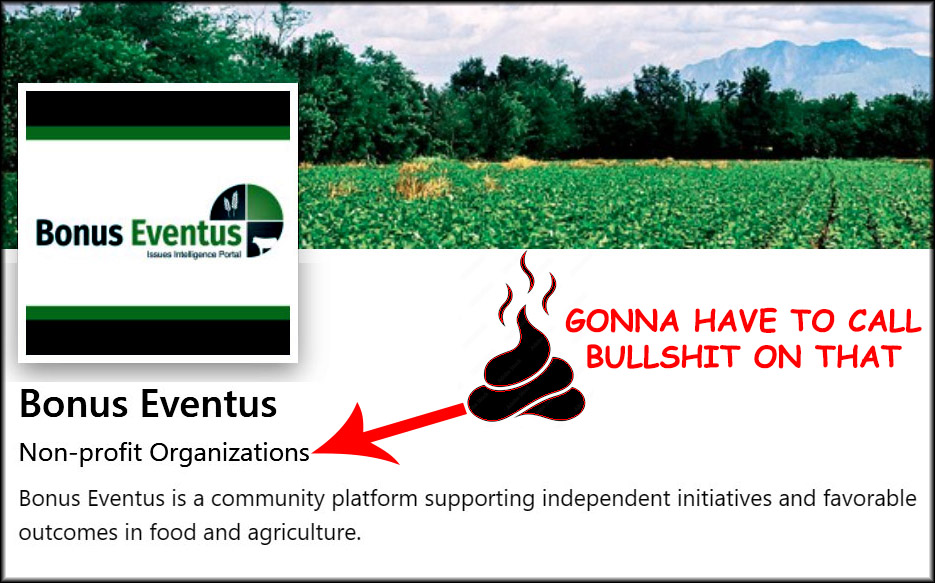
This oppo-research platform has a name: Bonus Eventus, I shit you not. (Does this not sound like a porn star screen name? Now appearing in Hot and Horny Green Activists…). Although literally translated as “good outcome,” Bonus Eventus was a Roman god of agriculture, but kind of an also-ran god. Ceres had the top job and she concerned herself with weighty issues of fertility and cycles of life and death; Bonus was the guy you sacrificed a rooster to give your barley crop a boost.

Bonus boasts dossiers on over 3000 organizations and 500 individuals who have said or written something about pesticides or GMO’s. The obvious (and only conceivable) use of this trove of tea is as ammo for denigrating and attacking anyone critical of GM crops or pesticides.
I have no idea how any of this has been, or will be, used against me, but I know that in the world of critics, I’m small potatoes; Bonus has much fatter dossiers on some science writers (they seem obsessed with Michael Pollan), lawyers (like members of the UN Panel on Food Security), and scientists galore.
Bonus and the company behind it, v-fluence, are the spawn of Jay Byrne, a former Monsanto comms flack – turned media hitman. Jay fashions himself as a “public relations executive.” This is technically true, although in the world of PR he’s like the enforcer on an NHL team — the toothless thug who can’t pass or score but lives to smash opponents into the boards.
What’s amazing is how many of the people they smash into the boards are scientists or science writers — given that industry’s long-standing insistence that agrichemical and GMO controversies pit science against anti-science activists. Industry claims to be the scientists, the ones trying to feed the world with safe and effective modern agricultural technologies; the critics are the activists, ignorant dreamers, stooges for Big Organic, yoga teachers. They have been beating this drum for years, but the recent revelations about Bonus put it in a new light. I provide links below, but first let me entertain you with a glance back at the agrichem industry’s history of scientist-bashing. This is a deep and ugly history but I’ll stick to two of my favorite highlights.
1. Getting Loud about Silent Spring
Rachel Carson’s 1962 best-seller Silent Spring sounded the first major warning of the environmental dangers of the rampant post-WW2 use of agricultural pesticides — especially DDT. This was the agrichemical industry’s first major public brush with skepticism from scientists (yes, Rachel Carson was a scientist, although Silent Spring was a trade book). The smear-the-scientist strategy was hatched to deal with the Rachel shitstorm. DDT producer American Cyanamid took the lead, fielding the mustachioed academic biologist Robert White-Stevens to roam the country in a lab coat denouncing her book as distorted, inconsistent with “modern science,” and Carson herself as “a fanatic.”

A few years later, Green Revolution hero Norman Borlaug piled on. The tireless agrichemical promoter lit into the “vicious, hysterical propaganda campaign … by fear provoking, irresponsible environmentalists” like Rachel Carson’s “diabolic, vitriolic, bitter, one‐sided attack on the use of pesticides”.
But this was industry on the high road. More commonly, as Patricia Hynes notes, “industry and government aimed to discredit the book by discrediting the woman” — they “sexualized their contempt for her.” In an eerie prequel to JD Vance’s diatribes on childless cat ladies, one editor accused her of worrying more about cats’ deaths from DDT than children’s deaths, while another said that he “thought she was a spinster {code for lesbian}, so what’s she so worried about genetics for?” She was branded dangerous, irrational, and of course hysterical.

Ah yes, hysterical — the h-bomb in agrichem counter attacks and the uber-slur for female critics, from the Greek hystera for womb. Women scientists are either hysterical or the cause of hysteria. Hippocrates himself was the original source on hysteria, but it wasn’t PMS he thought made women spout nonsense — it was their uterus wandering around inside. Plato further proposed that it was the frustrated unproductive uterus that wandered off and knocked the woman off her game. And that Plato was one smart cookie, so maybe childless cat ladies really are unreliable interlocutors.
But no, it was the cool, collected, childless feliphiliac on whom scientific history would smile, not the agrichemical apologists with their apoplectic, spittle-flecked, misogynistic screeds. DDT’s ecological impacts were as bad as Carson warned but its impact on human health turned out to be worse than she could have known. In 1962 she could cite no evidence that the pesticide was a human carcinogen, but four decades after her death, it was shown conclusively to be a potent cause of the very disease that killed her — breast cancer.1
2. Chapela and the Sock Puppets
Sounds like a late-60s indie rock group doesn’t it? It isn’t. In 2001 Berkeley ecologist Ignacio Chapela and his student David Quist reported in Nature that GM corn had contaminated (“introgressed”) native corn varieties in Mexico. The GM/pesticide industry, already reeling from the hostility its products had encountered in Europe, was furious. The day the paper was published, the AgBioWorld listserv (read by >3000 scientists) lit up with ad hominem attacks, most stridently by new contributors named Mary Murphy and Andura Smetacek. They insisted that Chapela was biased, an activist, just out to make money from speaking fees by fear-mongering. Moreover, organizations that criticized GM crops were “terrorists.”
Mary and Andura did not sleep. They relentlessly attacked Chapela in personal terms, and then directed readers to the Center for Food and Agricultural Research, whose website had the straight dope on all this anti-GMO “activism.” The CFFAR website featured two happy brown-skinned kids in a farm field, but its content was mainly decidedly unhappy snarling denunciations of the GM/pesticide industry’s perceived enemies, including many scientists. (E.g., Michael Hansen was “the crown prince of cancer scares” and a Commie-lover.)
But it didn’t take much sleuthing for British writer George Monbiot to trace Mary Murphy and Andura Smetacek back to Bivings Woodell — a PR firm that prided itself on promoting messages in the guise of “an uninvolved third party.” (It was working for Monsanto, whose chief internet strategist at the time was our pal Jay Byrne.) When Monbiot emailed Murphy, “she” only replied that she had “no ties to industry”. LOL; neither she nor Andura actually had ties to anything, even corporeal existence — they were fictitious personae, invented by nattering nabobs hired to mug scientists.
Ditto for the CFFAR — no office, no staff, and no earthly existence beyond the flimsy website festooned with attacks on GM critics. The URL was registered to a Bivings exec. It, along with its imaginary henchwomen, suddenly vanished, never heard from again. Raptured to Sock Puppet Heaven perhaps.
After a bit, the URL was replaced by a placeholder urging one to “sip a clean cup of herbal tea”

Because of his scientific research — plus his vocal opposition to a controversial deal whereby UC-Berkeley sold rights to his department’s research findings to a biotech firm — Ignacio Chapela left a throng of fist-waving critics in his wake. But his finding that transgene contamination of native maize would eventually be confirmed — repeatedly.2 Chapela was a sometime activist, but his Nature paper was science.
It’s News. But is it New?
This Bonus Eventus is news, but is it something new under the sun? Well yes and no.
The fact that it was exposed and found to be newsworthy in publications like those listed below is new and surprising. Kind of amusing too, to see so many of the entities who subscribed to it head for the exits (shouting over their shoulders that they didn’t set it up! never even logged in! well not much anyway!). But ad hominem attack has been agrichem’s go-to response since scientists began questioning their products.
Getting academic individuals and institutions to suit up and help has been surprisingly easy too — that’s not new. Universities are just as money-hungry as corporations, and lab science faculty have to be professional money-raisers — but they appear to be cloaked in scientific objectivity. Academic scientists “have a big white hat in this debate,” as a PR exec gushed to an academic recruit to the battle against critics.
A big white hat and an even bigger tin cup. The Gates Foundation — the world’s richest philanthropy — paid for an agrichem propaganda operation to demean science that diverges from industry claims. It’s called the Alliance for [you guessed it…] Science and it is housed at Cornell University. For instance, see Alliance employee Mark Lynas’ Seeds of Science. The whole point of this turd of a book is to pump up Lynas into a former anti-GMO leader (LOL he wasn’t) who somehow awoke from his demented green slumber to expose his former comrades as “grungy” activists who don’t know what DNA is (Mark didn’t). As this droll review shows, he focuses on a small handful of campaigners in an attempt to whisk from view the enormous body of critical peer-reviewed research from natural and social scientists.
Thus, behold the sorry spectacle of an Ivy university pimping out its respectability in exchange for a bagful of benjies. (Just like my old employer Washington University, which slurped it on down when fossil fuel companies threw it a bone to house a greenwashing “clean coal” institute. The Wash U faculty was docile about it all, but not the undergrads, who routinely showed up to spray a shit mist over “clean coal” events. But I digress.)
How about sponsorship from the US government — new? Well direct payments to an agrichemical PR firm would be new, but that’s not technically what happened. The USAid, which is all in when it comes to helping US companies sell agrichemicals in the Global South, made out their check to the International Food Policy Research Institute. IFPRI, like all centers in the CGIAR international agricultural research network, claims to care only about “hunger and poverty”, but it understandably cares even more about its own poverty. As funding has steadily dried up and positions axed, these centers have increasingly resorted to turning tricks, directly or indirectly, for the agrichemical industry. So USAid venmo’ed IFPRI $400,000+ which IFPRI then venmo’ed v-fluence to go through critics’ laundry.
I’m the last person to argue that it’s new for the government to spend money to buck up chemical agriculture. My recent book The Agricultural Dilemma is all about how industrial agriculture arose because of the shared interests of government and agricultural input companies, but at the expense of environment, public health and appropriate levels of food production. So in a general sense, no, not new at all.
But in a specific sense — well a personal sense — it feels new. After funding my scientific research, my government funded a propaganda platform concocted by a Monsanto bagman to pore through my publications for tidbits to take out of context — the only purpose of which would be to help industry stooges smear me. Obviously other scientists are welcome to debate my work, but they hardly need anything on Bonus to do so.
So hey, other scientists and science writers — how has the US spent money on you?
Now for the Investigative Journalism
The new reporting is the fruit of a collaborative effort by those rare and wondrous (and critically endangered) beasts, investigative journalists.

The badass reporters at Lighthouse Reports did most of the shoe leather work — including FOIA requests, money-trails analysis and public spending record searches. Margot Gibbs and Elena DeBre get major credit for this work, and let us raise a glass to them.
They collaborated with journalists at major outlets across the globe, leading to a set of articles that each explored different areas of interest, including:
THE NEW HUMANITARIAN considers the industry push for pesticides into Africa (like paraquat…Parkinson’s Disease, anyone?)
THE GUARDIAN‘S coverage by Carey Gillam (of Whitewash fame) is good on machinations within the US government, from USAID to the White House Writers’ Group.
LE MONDE published a 3-part series by the ever-inquisitive Stéphane Foucart
-> Investigation Reveals Mass Profiling includes more on specific scientists targeted on Bonus
->Diving into the Black Box of Global Pesticide Propaganda includes entertaining denials by subscribers that they had anything to do with v-fluence
-> and How Trump’s Administration tried to Torpedo the EU Green Deal using Influence and Misinformation Campaigns is great on, well, how how Trump’s administration tried to torpedo the EU Green Deal using influence and misinformation campaigns.
Notes
1. The go-to for current research on long-term health effects of DDT is the UC-Berkeley epidemiologist Barbara Cohn and her collaborators. After many studies failed to identify a carcinogenic effect for the pesticide, Cohn’s team found a way to compare adult health to pre-puberty exposure to DDT, and boom — it’s carcinogenic as hell.
2. Quist and Chapela’s 2001 paper also claimed that in some cases the transgenic DNA construct had broken apart, a finding that since been discounted. The much more important finding of introgression has been confirmed repeatedly:
Piñeyro-Nelson, A., et al. (2009) “Transgenes in Mexican maize: molecular evidence and methodological considerations for GMO detection in landrace populations.” Molecular Ecology 18:750–761.
González, C. A., et al. (2016). “Genetic diversity and presence of transgenes in Mexican maize landraces.” Molecular Ecology Resources, 16(3), 628-639. doi:10.1111/1755-0998.1246
Arriaga, A., et al. (2020). “Transgenic contamination in maize landraces: A case study from Oaxaca, Mexico.” Plant Genetic Resources, 18(4), 275-282. doi:10.1017/S147926212000019X
Zavala, J. A., et al. (2019). “Detection of transgenes in maize landraces in southern Mexico: Implications for agricultural biodiversity.” Environmental Biology of Fishes, 102(1), 45-57. doi:10.1007/s10641-018-0841-6
Mora, L., et al. (2021). “Survey of transgene presence in maize populations across Mexico.” Journal of Agricultural and Food Chemistry, 69(10), 3071-3080. doi:10.1021/acs.jafc.0c07399
 fieldquestions

Amazing that this is going on, and supported by the federal government. What I want to know is how you found out about your file.
Someone who had come into possession of dossiers shared it with me and asked for comment, but asked that I not disclose how I got it. Sorry to be cloak-and-dagger about it, but I agreed. I know several other folks who want to know what’s in their files but haven’t been able to find out.