Gone are the Days when the Ox Fall Down?

Last year my daughter’s boyfriend sent us a bottle of red wine from a biodynamique winemaker in the Loire Valley, along with a note explaining that “he uses a horse named Joker to plow fields and transport grapes.” A slightly risky choice for a gift (this wine really puts the terre into terroir) but I loved it as well as its backstory. There’s something rather thrilling about animal traction in this day and age.

Bullock plowing lessons in Andhra Pradesh.

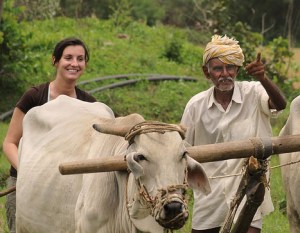
I take students to rural India in the summer, and for many of them the “I don’t think we’re in Kansas any more” moment comes at the first sight of a farmer behind a bullock or buffalo plow. (Then of course they started demanding plowing lessons…)

I was tickled to play a small role in the donkefication of Missouri a few years ago. I was emailing with a couple who run an organic herb harvesting operation in the St. Francois mountains and they asked me if I knew anything about donkey traction. (Yes, there is such a thing as certified organic wild goods, and one criterion is that they are transported out in a non-destructive manner.) I connected them with an animal traction expert in England who talked their ear off. I assumed they would soon be running a fleet of donkeys but it looks like they are making do with one.

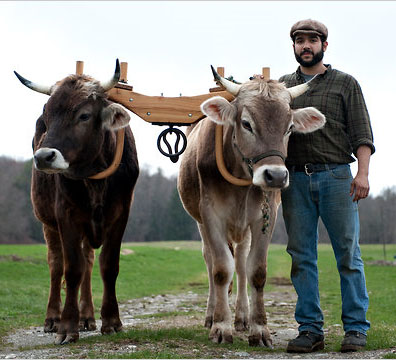
In the US, animal plowing is best known on Amish farms where it is actually less environmentally friendly than you might assume. But animal traction is making a surprising comeback on other American farms, to the point of a major article “On Small Farms, Hoof Power Returns” in today’s NY Times. In Michigan, Tillers International runs workshops on animal plowing and last year over 300 farmers signed up.

For people who already scoff at organic farming’s avoidance of pesticides and GMO’s, ditching the tractor for the ox must seem like the ultimate lunacy. But as Deborah Fitzgerald shows in Every Farm A Factory, tractors aren’t inherently better, just different, and they replaced animal traction in the 1920s only because of an unusual intersection of factors. War-related labor shortages coincided with engineering schools turning out “agricultural engineers” who sought to earn their spurs by persuading farmers to adopt industrial machines and mindsets.

Studies in the 20s showed that tractors often required more time and work than doing the job manually, and that tractor buyers didn’t come out ahead economically. Tractors were wildly dangerous too. But as prosperous farmers began to adopt (for the complex and partly non-economic set of reasons that farmers adopt things), the tractor became the mark of farmer prosperity, and before long banks stated using tractor ownership to evaluate creditworthiness.

Expensive tractors, larger farms, and higher loans all amplified each other in a perfect storm of overproduction. There was already more than enough food pouring out of American farms without tractors, and now as the grain-eating draught animals disappeared, a crisis of over-supply started to drive farmers out of business. As economist EG Nourse put it in 1927, “the outlook for agricultural production is so good that the outlook for agricultural prosperity is distinctly bad.”

Today I hope we are beginning to understand that agricultural prosperity comes in different forms. When we hear about retro technologies like oxen, it’s like a reflex to ask if they can make enough food, but the brutal truth is that we make too much food and we make it badly. The small but growing ranks of oxplow farmers are making an unexpected contribution to agricultural prosperity by helping to provide a viable alternative to overproduction of artificially cheap commodity crops by heavily subsidized, cost-externalizing agribusinesses.

Posted in Agriculture | Tagged | 3 Comments

Baseball Bats and Breast Cancer: The Court Mulls Over Gene Patenting

A few weeks ago in a courtroom in Washington DC, lawyers with the blessing of the US Dept. of Justice (DOJ) argued that gene patents are invalid.  The judges of the Court of Appeals for the Federal Circuit are now mulling over the question and we should be too.

This was in the famous Myriad genetics case which has brought gene patenting to the attention of so many people who hadn’t thought about it before. It gets your attention your test for the “breast cancer gene” (BRCA1 or BRCA2) costs $3000, and it piques your curiosity when you learn the gouging is allowed by a public university owning gene patents and licensing them to a biotech company started by one of its professors.

Last year in District Court, the plaintiffs (the ACLU and others) challenged gene patents in general and won a surprising victory, sending the case to the Court of Appeals (and possibly on to the Supreme Court, which has only taken one other patent case).  The Court of Appeals received a head-turning amicus brief from the DOJ calling for an end to gene-patenting.  There was also a brief from the  Assn. of University Technology Managers in favor of gene patenting; universities love to use your tax dollars to study and patent genes, which they then sell or license to biotech companies, without paying taxes on profits.  Case in point: patents for the BRCA genes are held by the Univ. of Utah and licensed exclusively to Myriad genetics, co-founded by Utah adjunct professor Mark Skolnick.  Much of the funding came from the National Inst. of Health (which the patent application didn’t even mention this until NIH challenged the patent).

But how could genes be patented in the first place?  Products of nature have always been exempt: no one can patent a bird’s nest, a shark’s fin, or an oak tree.  When an “inventor” applies for a patent, the US Patent & Trademark Office (USPTO) first makes sure the “invention“ is eligible to be patented – i.e., it isn’t a product of nature and most definitely not a human being – and then checks to make sure it is “new,” “useful,” and “nonobvious.”  Newness, or novelty, is a crucial concept, sometimes used counterintuitively in intellectual property circles, and some stunningly silly inventions have been deemed new (one of my favorites being the comb-over, and how Donald Trump manages to evade prosecution for infringement is a question for greater legal minds than mine).  Normally, “new” means it wasn’t part of the “prior art” — the extant body of knowledge — but it’s also the key to whether DNA “inventions” are even patent-eligible.  If you can convince a court that your invention doesn’t exist in nature, then by definition it must be “new” and therefore patent-eligible.

There’s your trouble.  There are no general rules for telling the “new” from the “old, just tweaked a bit.” Obviously the criteria have to vary with different kinds of inventions.  Biotechnologists started copying, altering, and moving DNA before legislators had even tried to legislate what would be patentable in the biotech era, and so judges just started judging it…based on …what?  Based on whether they got a “new” vibe after the lawyers were finished describing the invention.

You think that’s uncharitable?  Consider:

  • In the Chakrabarty case, the US Supreme Court looked at a bacterium with one added gene and opined, 5-4, that it looked new because it was a “nonnaturally occurring composition of matter”
  • In the Harvard case,  the Canadian Supreme court looked at a mouse with one added gene and said it didn’t look new at all — “the mouse is still the same mouse even if one gene is changed, just like you are the same person after you are radiated”

A few years later, when the famous Percy Schmeiser case got to the Canadian Supreme Court, there were more disagreements on what was and wasn’t “new.”  (Percy was the Saskatchewan farmer sued by Monsanto for replanting his own canola seeds after his field was contaminated with Monsanto’s patented seeds.  He successfully sued Monsanto for contaminating his field, but they successfully sued him for replanting his own seed, because it wasn’t his own seed any more since they had contaminated it.  You can’t make this stuff up.)  In a 5-4 decision upholding the validity of Monsanto’s patent, the dissenting judges said that even if Monsanto’s genetically modified cell had a “new” vibe, its daughter cells didn’t: “the plant cell claim cannot extend past the point where the genetically modified cell begins to multiply and differentiate into plant tissues, at which point the claim would be for every cell in the plant.”

The appellate judges are now being asked to clarify what categories of DNA “inventions” give off “new” vibes.  As the DOJ sees it, the District Court saw too many things as products of nature, even casting doubt on the patent-eligibility of “genetically modified crops…[that] are in every meaningful sense the fruits of human ingenuity and thus qualify as ‘human-made inventions’”.  The DOJ does get “new” vibes off of GM crops (unlike many Canadian and American judges), just not off the genes themselves.

Is it really all so subjective?  Surely there is a legal basis for separating inventions from products of nature beyond the “new” vibe?  There is indeed, and this is the most interesting part of the story, although it never really escapes the subjectivity of newness:

Back in the early 1900s, some patent applicants argued that if you artificially isolate a product of nature, it can have new qualities; so it’s an invention.   A spirea bush was a product of nature, but aspirin isolated from it was an invention; an adrenal gland was a product of nature, but purified adrenaline was an invention.  Then in 1979: bacteria was a product of nature, but a pure strain of a bacterium was an invention.

Well now, biotech routinely involves artificial isolation of DNA, so the argument was almost inevitable: a chromosome is a product of nature, but an isolated gene (or other DNA segment) is an invention.  This is exactly what happened in the 1991 Amgen case, which was a fight over which company owned rights to genes for a human protein called EPO (same stuff Lance Armstrong has been accused of injecting).  Amgen claimed the EPO gene was an invention because it was “purified and isolated” by being identified and reproduced outside its natural environment.  Clearly feeling the “new” vibe, the Federal Circuit found that no one “invented EPO or the EPO gene,” but the patent was for “the novel purified and isolated sequence which codes for EPO”.  Since then, tens of thousands of genes have been patented on this rationale, including over 20% of human genes.

Let’s leave aside the ethical, political, and economic problems with gene patenting; there is a profound problem in the legal logic.  Yes, it is conceivable for an isolated & purified substance to take on qualities different from the same substance in its natural form, certainly enough to give of a distinct vibe of newness.  But as John Conley points out, “the entire utility of the claimed isolate lies in the fact that it is functionally indistinguishable from the natural version.”  That is: the only thing a gene does is to carry information in its DNA sequence; if the isolated & purified version carries the same information then by definition it does the same thing.  If the isolated gene really were different than the naturally occurring gene, then they couldn’t claim rights over the naturally occurring gene, could they?

The ACLU et al. used this argument before the Federal Circuit court, asking how the DNA could be an “invention” when “Myriad’s entire business is based on isolated DNA being identical to” chromosomal DNA.  None of Myriad’s arguments rebut this.

Myriad’s lawyer, asked why the DNA product was a human  invention rather than the handiwork of God, replied that “only God can make a tree” and yet a baseball bat can be patent-eligible; the isolated DNA had been embedded in a chromosome just as the bat is “embedded” in a tree.  Isolated DNA, therefore, is not made by God but is the product of “molecular biology” and human ingenuity.

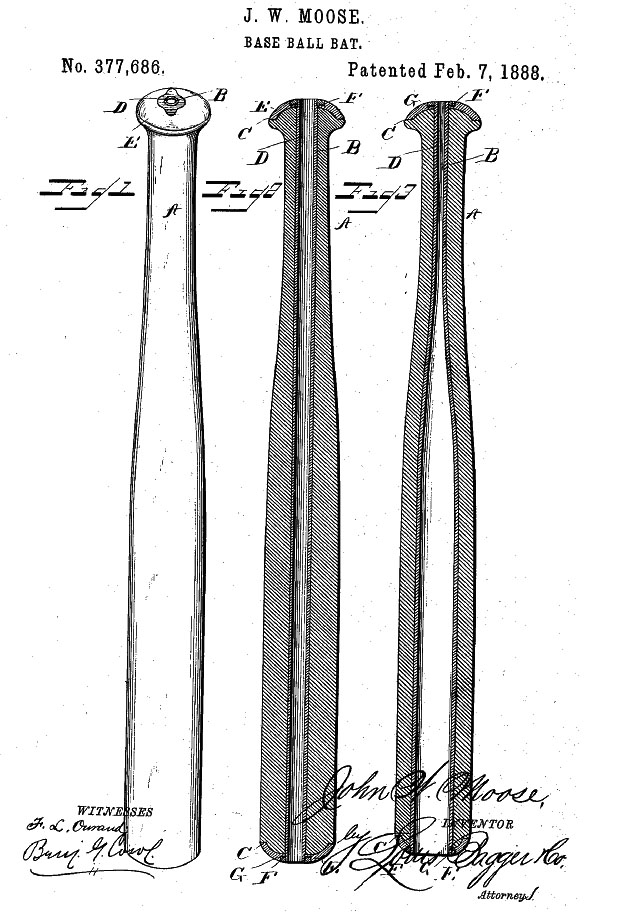
(Reality check: the baseball bat was never patented; it has long been part of the prior art of sports.  All the baseball bat patents are on inventions that improve or change the bat, starting with JW Moose’s hollow core bat in 1888.  I do get a “new” vibe from this, and now I am wondering if Sammy Sosa wasn’t infringing some patents all those years.)

Much (although not all) of what is being written is critical of the plaintiffs’ (and DOJ’s) stand, and the betting is on a ruling for Myriad and gene patents. Given the economies and institutions that have developed around gene patents, abolition would be a nuclear option that is hard to imagine.  But it’s just as hard to imagine a legal rationale that is as patently flawed as the rationale for gene patents.

(And to think that I almost got through the whole posting without making that pun.)

Posted in Biotechnology, Intellectual Property | Tagged | 7 Comments

GM Eggplant and Ayurveda in India

India may be the world’s most closely-watched arena for the spread of genetically modified (GM) crops, but it has allowed only one of these crops so far — cotton.  Until recently it looked like its first GM food crop would be eggplant — called brinjal in India — modified with a Bt gene to produce an insecticide for the “fruit and shoot borer.” After years of testing and public debate, Bt brinjal had been okayed by the Genetic Engineering Approvals Committee and seemed headed for release.

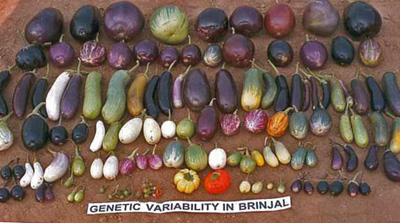
Brinjal vendor, Warangal. Photo G. Stone.

However in February 2010, Environment Minister Jairam Ramesh declared an indefinite moratorium.  There was a major meeting on the topic in Delhi this week, and many thought that moratorium would be lifted.  But the only decision seems to have been indecision, and Bt brinjal remains in limbo.

The struggle over GMO’s is often depicted as an archetypal clash between irresistable force (science, progress, and productivity) and immovable object (Luddites, tradition-bound romantics, and overfed food snobs).  But it is becoming increasingly clear that each GMO controversy has its own backstory, and with Bt brinjal the story is particularly interesting.  This fight, oddly enough, turns out to have everything to do with Ayurvedic medicine.

But before we get to Ayurveda, let’s recognize that there were other issues in the brinjal fight as well.  One factor, perhaps surprising to some with the production-maximizing mindset, is the skepticism that the amount of food produced is really India’s problem.  India, after all, is the country that gave us Amartya Sen, and today it has both the world’s largest number of hungry people and an ongoing crisis of overstocked government granaries.  At one boisterous public hearing on Bt brinjal, one person asked if “we really need more brinjal” which, upon closer inspection, is a good question.  Minister Ramesh’s report points out that the question of “why Bt-brinjal” remains unanswered, as “there does not seem to be any over-riding food security, production shortage or farmer distress arguments” for it.  Just last month, the Times of India reported that “heavy flow of [brinjal] produce due to high yields has resulted in a slump in prices” bad enough to lead vendors to abandon their piles of brinjal in disgust.

(Interesting how often these new production-increasing technologies come along during gluts.  Monsanto’s first commercial GMO was rBGH, designed to raise milk production … just as the USDA paying dairy farmers $1.8 billion to slaughter cows to reduce overproduction of milk.)

There is also discomfort in India at Monsanto’s increasing control over the seed supply, and not just among the anti-GMO activists.  Citing government scientists, Minister Ramesh complained that Monsanto had gained direct or indirect control over “a vast proportion” of the Bt cotton seed now being planted by 90% of Indian cotton farmers.  Bt brinjal may have been developed by the Indian company Mahyco and by two Indian agricultural universities, but Ramesh pointed out that Mahyco was partly owned by Monsanto, and there were concerns about who had funded the work by the universities.

But most troubling to Jairam Ramesh was the question of outcrossing — especially the spread of transgenes to wild eggplants.  India is a center of diversity for the genus Solanum, with over 1500 known species (one eggplant species is domesticated, the rest wild).  The ecological effects of transgenes in the wild species are not well known. The transgenic hybrids would have to be able to make fertile seeds and any new traits would have to be able to spread before there was significant effects.  These things vary by plant,  environment, and many other factors, and they are hard to study.  Sometimes research into these questions is blocked by the very biotech companies who adamantly champion the “science-based approach” to food and farming.  (A notorious case was that of ecologist Allison Snow, whose research into outcrossing in Bt sunflower was abruptly stopped by the patent-holder when she started to find that the wild Bt plants thrived.)

Still, several studies have shown that domestic brinjal does outcross with its wild relatives, and the “expert committee” report on which the GEAC based its approval was seriously  flawed — at least according to an impressive list of ecologists who expressed their concerns to Ramesh (including Allison Snow, Norman Ellstrand,  and David Andow).

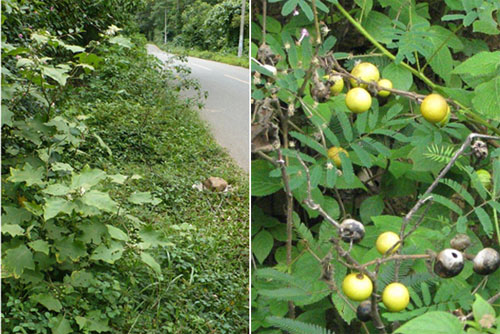
The reason this is particularly important is that wild eggplants are commonly used in Ayurveda, and Ayurveda is enormously popular — indeed, it is big business, especially in the prosperous state of Kerala.  This ancient, text-based system comprises medical treatments, massage, diet, and wellness retreats, all of which make intensive use of  herbs.  According to anthropologist Chith Kudlu, who has spent the last 4 years studying the Kerala Ayurveda trade and its changing pharmacopia, around 600 herbs are used in over 500 concoctions, an estimated 80% of which are gathered from the wild.  With around 2 million Ayurvedic practicioners, 7900 Ayurvedic manufacturers, and over $2 billion in annual international and domestic trade throughout India, wild herbs take on an unexpected cultural and economic importance.  Six different eggplant species are used in Kerala Ayurveda, all growing in the wild and some highly weedy.

Wild eggplant on a Kerala roadside. Photo C. Kudlu.

Genetic engineering seems to be inherently incompatible with Ayurveda.  In 2008 scientists at two institutions genetically modified Brahmi and Kariyat, two herbs commonly used in Ayurveda, to boost their expression of compounds thought to be anti-carcinogenic.  The plants were roundly condemned by Ayurvedics, whose formulations are based on the holistic character of plants and synergistic effects of plant combinations rather than on individual phytochemicals.

Kudlu points out that since wild eggplants are used in both Ayurvedic food and medicines, a proper assessment of potential impacts of transgenes would have to be different than conventional food analysis.  She notes that

Unlike food, medicine is given in highly concentrated form, and it is given to sick people whose tolerance for some compounds may be compromised.  Ayurvedic medicines are also polyherbal, involving interactions of dozens or hundreds of compounds. Ayurvedic medicine is also prepared in water-soluble, alcohol-soluble, and fat-soluble forms, each of which extracts different sets of metabolites.  All these variables will have to be taken into account in conducting toxicity tests.

Kerala’s chief minister (governor), V.S. Achuthanandan, was prominent among those who wrote to Ramesh as he was making up his mind, arguing that Kerala

is an important centre of diversity of medicinal plants and heritage of traditional medicines like Ayurveda. Serious concern has already been expressed by the Ayurveda practitioners on GM research being undertaken on various crops… the State has already declared an Organic Farming Policy, Strategy and Action Plan in 2008. Accordingly, the entire food crops would be converted to organic within five years and the cash crops within another five years. This will, apart from helping to feed the people with non-poisoned food, enhance our export possibilities with a high premium. However, introduction of GM crops will certainly defeat the very purpose of organic farming, because GM crops/foods are more disastrous than those from crops raised using chemical pesticides and fertilizers. It would also kill the State’s trade prospects.

The best course of action, wrote Achuthanandan, would be a 50 year moratorium.

Ramesh’s moratorium does not have a set length, but it was indeed justified in part on fears that Bt brinjal would endanger the plants’ “medicinal properties due to loss of synergy, differences in the alkaloids and changes in other active principles.”

– – – – – – – – – –

See my article with Chith, “The Trials of Genetically Modified Food: Bt Eggplant and Ayurvedic Medicine in India“, in Food Culture & Society.
Posted in Agriculture, Biotechnology, Food, India | Tagged | 5 Comments

Blood type: Bt

A new study by toxicologists and obstetricians looks in the bloodstreams of a sample of Canadians for pesticides associated with genetically modified foods (new acronym alert: PAGMF).  They studied pregnant women, their fetuses (actually umbilical cord blood after delivery), and also a group of non-pregnant women.  GM-associated insecticide was widespread in the blood samples; GM-associated herbicide was present but rare.

Some background: the overwhelming majority of GM crops grown in the world today are either herbicide tolerant (HT) or insect resistant (IR).  Herbicide tolerance is from a gene for immunity to glyphosate (Roundup) or gluphosinate (Liberty) weedkiller, allowing the farmer to spray weeds without harming the crop. Insect resistance is via a gene from the soil microbe Bacillus thuringiensis (Bt) which produces an insecticide — hence the name “Bt crops.”  Canada mainly grows a lot of HT canola, but it grows other GM crops too including some Bt maize (details here).

Bt insecticidal proteins were found in the blood of 93% of the pregnant women and 80% of the fetuses.  The current thinking is they get into humans via meat from animals fed Bt crops — these proteins have been found in the guts of pigs and calves.

Evidence of weedkiller in the blood was much more scant.  None of the samples from pregnant women or fetuses were contaminated; 5% of nonpregnant women had glyphosate and 18% had gluphosinate.

What does this mean for health impacts?  Nobody knows.  There are some signs that high levels of glyphosate and gluphosinate disrupt fetal development, but the levels in the women in this study were low.  I know of no evidence that Bt proteins in the blood are harmful, and Bt is quite safe for humans in most contexts.  (And as one of our graduate students just suggested, we should look on the bright side — the babies should be protected from caterpillar bites.)  But there’s no contesting the authors’ conclusion: “Given the potential toxicity of these environmental pollutants and the fragility of the fetus, more studies are needed.”  A lot more.

Should this affect what we eat?  Or what we think about GM crops? Ah, as with so many things, it all depends on the counterfactual — i.e., what you compare it to.  You can buy organic produce that is free of weedkiller, and organic or most grassfed beef will be Bt-free.  You pay more for these foods, but then again they offer benefits beyond the avoidance of pesticides.

On the other hand, while low levels of Roundup in adult blood and the common occurrence of Bt in fetal blood may give us pause, try wrapping your mind around some of the findings on other pesticides.  Start with this article by Rauh et al. that just came out in Environmental Health Perspectives. They have been studying the effects of exposure to chlorpyrifos in the womb.

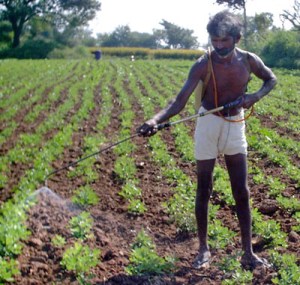
Spraying chlorpyrifos on lentils in Andhra Pradesh, India. Photo by the kids of the Kalleda Photo Project.

(Chlorpyrifos is a common organophosphate insecticide, sold under many named including Dow’s product Lorsban.  It is used on food crops in dozens of countries and it is a big favorite of the farmers I study in southern India, who use it on cotton and also food.)

Years ago Rauh et al. started looking at umbilical cord blood for chlorpyrifos in several hundred births.  They found some problems right off the bat — for example, the babies whose mothers had chlorpyrifos in their systems were smaller.  They checked the kids at 3 years, and found the chlorpyrifos kids had cognitive and behavioral problems.  Now the kids are 7 and this new study shows the exposed kids to have slightly lower IQ’s and poorer memories.

The spread HT crops into Canada and several other countries has not reduced weedkiller use — actually it has led to increases especially in the use of Roundup, but also to less use of other more toxic sprays.  The spread of Bt crops has reduced the use of chlorpyrifos and many other toxic insecticides, but we now know it means most babies (in Quebec anyway) are born with Bt in their blood.  What that means for our health and our  babies, we really don’t know, but it’s hard to resist the conclusion that it’s better than organophosphates in the blood, and worse than neither.

Posted in Agriculture, Biotechnology, Food | Tagged , , , | 6 Comments

Staph, Lies and Videotape

A new article in Clinical Infectious Diseases reports on an investigation of staph contamination (Staphylococcus aureus) on CAFO beef, pork, chicken and turkey in grocery stores in 5 US cities.  Staph was found on 47% of the meat samples, but what is particularly troubling is that over half of the staph samples were multidrug resistant.  It is clear that the CAFO’s are incubating drug resistance, and doing it quickly.  (For instance, fluoroquinolone antibiotics were used in in chicken CAFO’s from 1995-2005 and fluoroquinolone-resistant staph were common on the chicken samples — but not on the other meats).

(Multidrug resistant does not necessarily mean methicillin resistant, as in MRSA; this study only found 3 MRSA-contaminated packages out of 136 tested.)

If you are wondering when we are going to stop making meat “cheap” by steadily eroding the power of antibiotics, you could have gotten a partial answer from two other stories in the news at the same time.  Both show state governments bending over backwards to protect the interests of the CAFO owners:

  • The Missouri legislature just passed a bill that essentially protects Premium Standard Farms, the state’s main operator or hog CAFO’s, from lawsuits
  • Iowa, Florida and Minnesota moved to criminalize videos exposing conditions at CAFO’s — no more of those videos that keep us from enjoying our breakfast strips in peace.  Update 26 Apr 11: Mark Bittman of the NY Times weighs in on the ag-gag law.
Posted in Food | Tagged , , , | 2 Comments