Decide for Yourself

The dust has not settled after India’s decision not to approve its first genetically modified food crop.  In fact it has just been kicked up again today, with the prime minister accusing foreign NGO’s of meddling and activists responding that the real meddling is by multinational corporations.

This is much more than a local dust-up.  What’s at stake is not just whether Indians will have “Bt brinjal” (genetically modified eggplant) on their plates — it’s how we even make these decisions.

The decision to deny approval of Bt brinjal (at least until further research is done) was made by Environment Minister Jairam Ramesh.  The Genetic Engineering Approvals Committee normally makes these calls, and it voted for approval, but knowing well that India’s first GM food would be a hot potato, it asked Ramesh to decide.

Ramesh organized an unusually open consultation process — much more open than any other decision-making process I have ever seen on GMO’s.  He solicited opinions from state governments, scientists, farmer organzations, and Indian NGO’s.  He held open forums which were well attended; a lot of them are on Youtube and are pretty interesting viewing (Ramesh often challenges anti-GMO claims).

Public consultation on Bt brinjalRamesh — who was moved to a different cabinet post soon after his decision — has provided a careful explanation of his decision.

But we live in a world where with one click of the mouse you can see Ramesh’s actual report on his decision, and it’s an interesting and important document.  Now that the whole decision is being picked apart and spun with headlines and sound bites, it’s a wonderful time to click here and read for yourself.  Ministers Report on Bt Brinjal decision

But I’ll provide a few highlights:

  • All state governments that expressed opinions urged extreme caution.  One state even asked for a 50-year moratorium;
  • There are major unanswered questions about impacts on wild eggplant species (some of which have surprising importance in economy and medicine, the subject of a previous blog);
  • The claims that the decision was “anti-science” are hard to reconcile with the report’s reliance on input from top Indian biologists like P. Bhargava and international ecologists like Ellstrand and Snow;
  • The release would probably violate the Cartagena Protocol, of which India is a signatory.

There are more points there, all clearly laid out.  Decide for yourself.

Posted in Agriculture, Biotechnology, Food, India | 2 Comments

Bt Cotton, Remarkable Success, and Four Ugly Facts

Of all the crops and countries in GMO controversies today, few are as important than Bt cotton in India. GMO debates keep going back to small farmers and developing countries, and India has by far the most small farmers planting GM seeds.  (In Brazil and Argentina, which account for most of the GM plantings in the developing world, most of the GM seeds are planted by large commercial soybean growers.)

The ISAAA has recently put out a series of publications on the “remarkable success of Bt cotton in India” (see an example).  Articles by economists routinely attribute major yield gains in Indian cotton to Bt.  In a recent interview with Down to Earth I was asked to respond to the claim by a seed industry spokesman that Bt cotton showed “how a technology can double yield of a crop in 6-7 years.”

If all this is true, it is very important.  Is it?  Well I’m a data guy and I happen to have the latest data on Indian Bt cotton (courtesy of the Indian Cotton Advisory Board).  First let me say that I have already discussed the controversy over Bt cotton causing farmer suicides: the data just don’t support it.  But if we take a similarly objective look at the data on Bt cotton’s “remarkable success,” there are some equal surprises in store, and a few inescapable ugly facts.

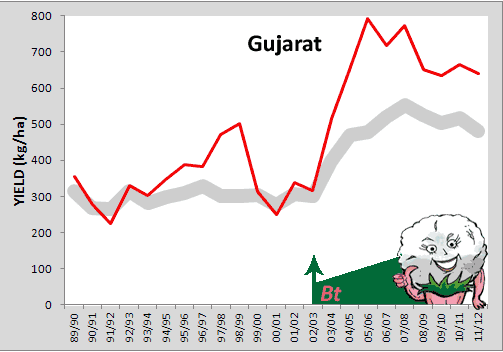
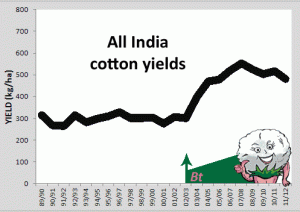
India approved Bt cotton in 2002; now it accounts for 92% of all Indian cotton.  Average nationwide cotton yields went from 302 kg/ha in the 2002/3 season to a projected 481 kg/ha in 2011/12 — up 59.3% overall.  This chart shows the trends in yields, which took off after Bt was introduced in 2002 (as we are constantly reminded by GMO enthusiasts).
(The depiction of Bt cotton as a coquettish boll is courtesy of the ISAAA’s Mandy and Fanny, subject of literary criticism in an earlier post.)

The problem is that while yields did take off right after Bt cotton was approved, this was well before hardly anyone was actually planting Bt cotton!  Look at this graph showing the yearly percentages of all Indian cotton land planted to Bt cotton.  Now here’s ugly fact #1: Most of the yield increase happened between 2002-5 when Bt comprised between 0.4-5.6% of India’s cotton.  Obviously Bt couldn’t have accounted for more than a tiny speck of the national rise.

The graphs also show that — and here comes ugly fact #2 — in the last 4 years, as Bt has risen from 67% to 92% of India’s cotton, yields have dropped steadily.

Could it be that there is more going on than just Bt adoption?  KR Kranthi, director of the Central Institute for Cotton Research (and as knowledgeable a person on Indian cotton as you are likely to find), writes that “While there is a general perception that Bt cotton technology was singularly responsible for the dramatic improvement of cotton fortunes in India, it is pertinent to examine other probable factors that may have contributed to the higher yields.”

One issue is the spread of poorly regulated private hybrid seeds that require pesticides; cotton farmers have been on a pesticide treadmill ever since.  The hallmark of the pesticide treadmill is short-term yield increases, and the yield increases in the early 2000’s probably had more to do with conventional pesticides than Bt.  KR Kranthi writes that the insecticide imidacloprid is

used as a seed treatment for protection against sap-sucking insects. Even a naïve student in India would know that none of the vast majority of Bt hybrids would have been able to sustain that onslaught of leaf hopper infestation without seed treated with imidacloprid. Gaucho, as it was known commercially, has been used in India since 2000 and was known to have contributed to at least 25% to 30% yield enhancement in the conventional hybrids, long before Bt cotton was introduced in the country. Since 2002, every Bt cotton seed has been treated with the highly effective insecticide, imidacloprid…
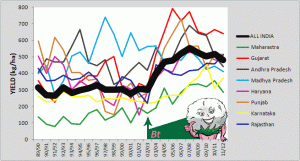
But it’s hard to generalize about a country that is as large and diverse as India, and those countrywide averages are hiding very different local patterns.  This chart shows the yield trends in the 8 states with significant cotton crops; the trends are all over the map.  Pretty messy.  So let’s zero in on the 4 biggest cotton producers (the legend in this chart gives their ranking based on cotton acres in 2011).

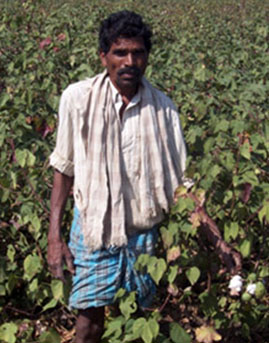
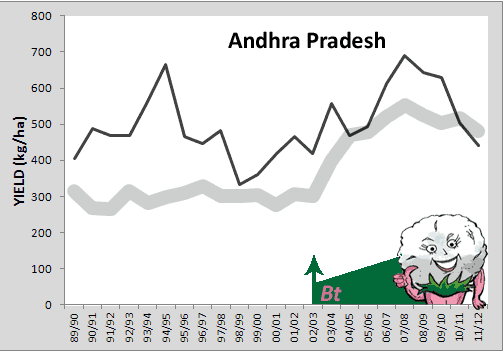
Let’s start with Andhra Pradesh, where I have been doing research for the last 12 years.  Yields did go up when Bt came along, but the upward trend clearly started after the 1997/8 season; farmers didn’t adopt Bt in significant numbers until 2005/6 which is 8 years after the yields started climbing.  (More on the A.P. story is available here.)  Then the ugly fact #3: since 2007, yields in AP have dropped back to below where they were before farmers started adopting Bt cotton.

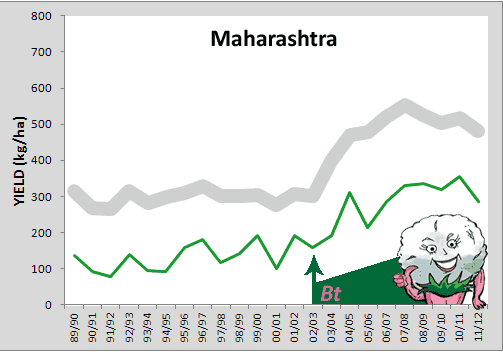
Now for Maharashtra, kind of like AP but not as pronounced: yields started rising well before Bt became popular, and now have dropped back to around where they were before.

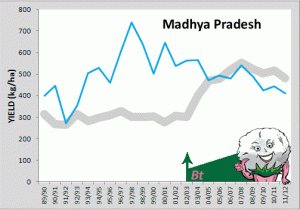
Next is Madhya Pradesh, where yields have been going down ever since the 1997/8 season.  Bt cotton doesn’t seem to have done anything to improve the steady slump.

Finally we get to Gujarat, which is where the real action is. This state accounts for most of the national rise in yields after 2002/3.  Nobody knows for certain how much Bt cotton was being planted in 2001-3 because there were illegal Bt seeds on many farms (it’s an interesting story). Bt, illegal or not, surely played a role in the rise in Gujarat yields.  So doesn’t that surge between 2000-2005 qualify as a “remarkable success” for Bt?
Here comes ugly fact #4: In Gujarat, the state mainly responsible for India’s remarkable rise in yields, there were many factors contributing to cotton yields other than Bt.  According to KR Kranthi:

It is important to consider that maximum productivity gains were obtained from the 0.6 million to 0.7 million hectares of new area under cotton in Gujarat, which had the benefits of more than 100,000 newly constructed check dams apart from the highly fertile soils that were under groundnut cultivation for several years before cotton was taken up. New technologies such as pesticides with novel modes of action…were introduced during 2001 and 2002.

Therefore, it is probable that the new pesticides, new hybrids, new micro-irrigation systems, new areas, and Bt-cotton together may have been effectively contributing to the enhanced rate of production and productivity. The role of Bt cotton in effectively protecting the crop from bollworms… cannot be underestimated, but need not be overhyped either.

I have read that the army of activists writing on GMO’s in India try to avoid the facts of the case.  I think on some issues –like the suicide narrative — that’s a fair charge.  But the counter-narrative of Bt cotton’s “remarkable success” also needs to he held up to the facts, and when you do, it gets ugly very quickly.

Bt did not “double yields” in 5 years.  National yields did rise from 302 to 554 kg/ha (up 84%) in the first 5 years after Bt was released, but almost all of that rise occurred in 2003/4 (when only 1.2% of the cotton was Bt) and 2004/5 (when only 5.6% of the cotton was Bt).  In short, Bt couldn’t have been responsible for the rise.

A more likely explanation for a rise in national yields in the early 2000s were the short-term gains from insecticides for sap-sucking pests.

Bt adoption didn’t top 10% until 2005/6; since then, adoption has climbed to 92%.  In that same period from 2005 to the present, national yields rose from 478 to 481 kg/ha — up 1%.

In none of the top 4 cotton-producing states do the trends fit the claim that Bt cotton has boosted yields. Even in Gujarat, where yield gains were most dramatic, the adoption of Bt was only one of several key changes in cotton production.

Over the last 4 seasons, with Bt adoption topping 90%, yields have dropped 13.2%.  In AP, where I have watched the Bt saga closely, yields are lower than they were before Bt became popular.  Now that’s ugly.

Posted in Agriculture, Biotechnology, India | 60 Comments

A Biotech Page-Turner

If you’re floundering around looking for a topic for your masters thesis in literature, allow me to submit for your consideration corporate media for children on GMO’s, a fascinating and understudied emerging genre.

I was first introduced to this genre by the CBI* 2000 classic, Closer Look at Biotechnology, in which two obese nerdy tweens get a heaping helping of neo-malthusianism as bugs crawl happily on the word “biotechnology,” showing that it is safe.  Along the way they learn to pronounce “by-o-tek-nawl-a-gee,” do fun word games, and learn that farmers who grew Bt cotton “were able to reduce the amount of insecticide used by more than 2 million pounds,” which was certainly the sort of thing I wondered about as a 10-year old.

But Closer Look looks almost like a comic book beside the recently published Mandy and Fanny: The Future of Sustainable Agriculture, a towering, can’t-put-it-down achievement in the field.  Appearing in the “India” section of the ISAAA website, M&F is a much more complex and challenging work, filled with bitterness and triumph, irony and humanity, sexuality and morality.  I laughed, I cried.

The eponymous characters turn out to be:

  • a deranged, acne-scarred corncob who looks unnervingly like a cross between Henry Waxman and the Heath Ledger Joker from Batman, and
  • a tarted-up cotton boll who wears no pants and has a wild bush of green pubic hair.

Long gone is the innocence of Closer Look, where magnifying-glass-wielding children were all smiles and and there were no villains except the planet Earth (which was just too small to feed everyone without GMO’s).   Now it’s time for youngsters to stop blowing bubbles and learn the word “hypocrite” and learn that medicine should be called “biotech pills.”

M&F is already been made into a major motion picture in which the Waxman Joker Corncob seems to have been voiced by Borat (“verry nayce”).  In the rousing climactic scene, the coquettish pantless female boll enflames a group of leering peasants with the cryptic come-on “We are conspicuous by our absence,” leading instantly to a group act that would make any Bollywood fan blush.

*CBI = Council for Biotechnology Information.  Want to read more about what they say and why?  See Science of the Gray or Both Sides Now.
Posted in Biotechnology, India | Leave a comment

New GM Grass: Unregulated and Unstudiable

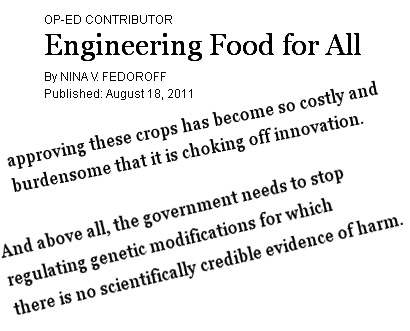
The NY Times recently published “Engineering Food for All,” a gushing op-ed by professional GMO proponent Nina Fedoroff that bemoaned the increasingly burdensome regulatory oversight of GM crops.  She went so far as to link world hunger to regulation of GMO’s.

I thought of her piece as I read 2 short pieces in the latest Nature Biotechnology.  Actually both of them concern news from last month, but the journal happened to print them side by side, and together they tell us something troubling about the regulation of GMO’s.  I find it troubling anyway, and I’m usually pretty unimpressed with chicken-little warnings from both sides of the GMO wars.

First let us remember how revolutionary it is to be able to move genes among organisms.  This technology is in its infancy but even its first baby steps include bacteria that produce medicines and food ingredients, and crops that resist herbicides and make insecticides.  Scientists are working on crops to improve nutrition and detoxify soil and animals to grow transplantable organs, to mention just a few feats.  It’s hard to even guess what may genetic engineers might do in the future.  (Someone on my campus recently suggested that we could even engineer animals so they didn’t mind being tortured in factory farms.  Hey, could we could engineer poor people so they didn’t mind being poor?)

But obviously genetic engineering’s potential to harm is equal to its power to help.  If you can make a crop that will kill bugs you can make a crop that will kill people.  If you make a crop that will detoxify the soil you can make a crop that will toxify the soil.  If you can make crops resist herbicides you can make bad weeds resist herbicides. If you can make a crop that will improve people’s health you can make one that will make people sick.  Fedoroff tells us that GM crops are “no more dangerous” than conventional crops but how is that even possible — how could a technology only do unprecedented good but no unprecedented harm?

How to manage the risks inherent in genetic engineering is one of the most pressing and difficult issues the world faces today.

The US and the European Union have approached the problem differently.  While the EU drafted new laws to deal with GMO’s, the US jerry-rigged a regulatory system using old  agencies and laws.  Regulators really only ask 2 questions about any GMO: how risky is it to public health and to the environment?  But depending on which gene has been inserted and what the plant is for, the responsibility for oversight may belong to the USDA (Dept of Agriculture), FDA (Food & Drug Admin) or EPA (Env Protection Agency).  This is called the Coordinated Framework.  It’s coordinated alright, but it’s also Byzantine, inefficient, and slow to adjust.  Almost everyone involved with biotech agrees that the US regulatory system sucks.

But does that mean that we just need “less regulation” as Fedoroff and some others claim?  Well, consider this: in the US you can create and release a GM plant into nature with no regulatory approval at all, and then prevent anyone else from studying its effects on health or the environment.  That’s what these 2 articles are about, so here’s a short explanation of both.

1. GM grass eludes outmoded USDA oversight.  People realized long ago that a GM plant could be made to fall right between the cracks in the Coordinated Framework.  The FDA checks plants if they are food.  The EPA checks plants if they contain a pesticide like a Bt gene.  The USDA checks plants made with plant pests — like Agrobacterium (a bacterium that causes a plant disease, used to insert the genes into the target) or the 35S promoter (from a plant virus).

But if you don’t use Agrobacterium (you use the gene gun instead), and you don’t use a pesticidal or disease gene (you use an herbicide-tolerance gene instead), and you don’t use a promoter from a plant virus… bingo, you slip right through the cracks.

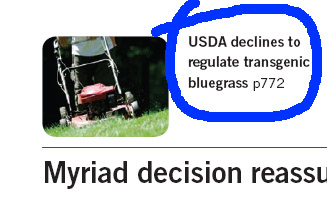
Which is exactly what Scotts Miracle-Gro did this summer with herbicide-tolerant GM bluegrass, and the USDA confirmed that it is outside their regulatory authority.  Since there is no basis for the EPA or FDA to evaluate it, it is the first example of a zero-regulation GM plant.  But is it just a fluke?  Hardly: Scotts is “blaz[ing] a regulatory trail” that will be followed by other companies, who are “salivating over this” notes a prominent biotechnologist.

No other country has allowed, or even considered allowing, completely unregulated GMO’s to be released into nature.  In fact, no court or legislative body in this country decided to do this either.  It’s just the result of a deeply flawed regulatory system.  Sure, it’s overly slow in approving some well-known technologies, but it’s overly fast for others, and sometimes even non-existent.

But won’t science tell us if this GM bluegrass poses health or environmental problems?   That’s the chilling part.  Consider the article on patents.

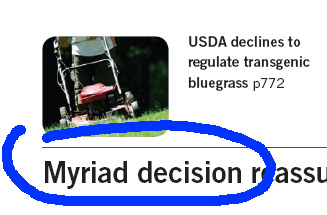
2. Myriad patents upheld. An appellate court has overturned a ruling invalidating Myriad’s breast cancer gene patents — and  essentially all gene patents.  It’s a fascinating argument covered in an earlier blog.  The issue turns on whether or not judges think that isolated DNA is truly different from natural DNA.  If it’s judged to be the same (using criteria that are not really spelled out in law) then it is a “product of nature” and no one can make claims on it.  But if it’s different, then it is eligible for intellectual property protection.  But what kind?  Answer: a utility patent, the 600 pound gorilla of IP protections.  Intended for actual inventions, a utility patent lets the owner stop anyone from making, using or selling the invention for a 20 year period.  Even for research. 

The “research exemption” issue has been duked out in the courts (dumb pun intended) especially in the Embrex case and in Madey v. Duke.  The only uses exempted from patent rights are narrow and slightly silly: if a company owns a patent on a gene or plant, they can stop any use except for “acts of amusement, idle curiosity, or strictly philosophical inquiry.”  A patent holder can absolutely keep you from doing any research with their gene or plant.

superweedAnd they do. Sometimes patent holders stop research right in the middle of a study.  Ecologist Allison Snow was forced to stop her research on ecological impacts of Bt sunflowers; entomologist Ken Ostlie was forced to stop his research on rootworms because one company decided the study was “not in its best interest.”  But more commonly, patent holders don’t even let the research start. In 2009, 26 leading scientists submitted an anonymous statement to the government saying that they were being blocked from doing necessary research by patent-holding companies.  (They remained anonymous for fear of patent holders spanking them by preventing more of their research in the future.)

Fedoroff writes that regulation of GM crops “has become so costly and burdensome that it is choking off innovation.” This misleading claim surely has many people thinking that regulation is getting tighter and tighter.  But in the US today you can create and release a genetically modified crop that has not been evaluated for health and environmental safety, and then you can block anyone from studying its safety.

So when Fedoroff concludes that “above all, the government needs to stop regulating genetic modifications for which there is no scientifically credible evidence of harm,” I can only wonder: how would anyone be able to get any evidence of harm for this genetically modified grass?

Posted in Agriculture, Biotechnology, Intellectual Property | 16 Comments

Putting the Germ into Germany

A truly frightening outbreak of E. coli food poisoning appeared in Germany in May.  Within a month it had infected more than 2,400 people in 13 countries across Europe, killing 23.

The toxic strain of E. coli is being called O104:H4 and no one is really sure what is behind it.  German authorities first claimed it was probably from contaminated cucumbers imported from Spain… but the evidence was slim, the Spaniards got mad, and the claim was retracted.   (The Spaniards then had to give away 40,000 kilos of legumbres to restore confidence in their products.)

Authorities then pointed the finger at beansprouts, delighting food scrooges because everyone knows that beansprouts are hippie food.  And in fact — ooh this is too good to be true — they were “locally grownorganic sprouts from a farm in Lower Saxony.  There was much gloating from the food right wing (e.g., Washington Times: “Dead Bodies Demand Organic Food Moratorium“).

Then ugly reality set in: tests on the sprouts were actually inconclusive, and the beans used in the sprouts weren’t even “local” — they were from southern Europe and Asia and were likely shipped via Hamburg and Rotterdam.  They decided it wasn’t the sprouts, and the hippies and locavores were off the hook (and the Washington Times printed a retraction…not). 

So the trail has grown cold.

Or has it?  There was a fascinating piece called “Phage on the Rampage” in Nature News, the journalistic arm of the journal Nature. It first points out that the real question is how the infectious bacteria get into the food chain in the first place. No final specific answer on that yet but we do know some important general things.

1. What’s killing people is the result of natural genetic modification.  The toxin in O104:H4 isn’t an E. coli toxin; it’s a shiga toxin, produced by a shiga gene inserted into the E. coli by a bacteriophage virus.  The modified E. coli has its own acronym: STEC for Stiga Toxin producing E Coli (to be mentally filed with MRSA for Methicillin-resistant Staphylococcus aureus).

Ugly little E. coli. But the ugly effects of strain O104:H4 aren't really its fault; it has been naturally genetically modified.

Actually, Shiga starts out in a bacterium.  I remember reading about shigellosis — bacterial dysentery — when we were getting ready to do ethnography in rural Nigeria.  (We never got it, but we got just about everything else.)  It seems the bacteriophage picked up the Shiga toxin genes from Shigella bacteria, and now is putting them into E. coli and other bacteria (here’s more on this, for the technically inclined).

Isn’t that something.  Bacteriophage viruses are doing what genetic engineers do: cut genes out of various species, stick them into E. coli, which then pumps out the compound the genes encode.  Numerous commercial products are produced this way (like recombinant Bovine Growth Hormone, and the chymosin in much of our cheese).

2. Circumstantial evidence now points to factory farms, not hippie farmers.  The most likely source of the STEC, says Nature News, is ruminant animals, whose guts have high levels of bacteriophages.  And this particular STEC has the unusual characteristic of resistance to multiple classes of antibiotics, so the bacteria are probably coming from where there is plenty of selective pressure to resist multiple antibiotics.   

Hmm, now where might we find lots of ruminants being exposed to subtherapeutic doses of antibiotics…

No word yet on how this STEC made its way from CAFO’s (factory farms) into the food chain, but that’s probably where the germ originated.

So this STEC is the result of “natural” genetic modification only in the sense that the genes are being inserted by bacteriophages, not by Monsanto whitecoats.  But the evidence suggests that these particular killer genes were moved into this bacterium because of conditions we set up in CAFO’s.

This is serious stuff.  “Not only are more E. coli strains being infected with Shiga toxin, but it seems to be moving into different classes of bacteria,” writes Nature News.  “This increased movement of Shiga-toxin-producing phage means that even more unusual and dangerous strains could be on the horizon.”

And it’s not the hippies you need to need to worry about, it’s probably the CAFO’s.

Posted in Agriculture, Biotechnology, Food, Industrial Agriculture | Tagged , , , , , , | 1 Comment

Feeding Hungry Indians

News today in the Bombay press about India’s worrisome food imbalance.

Too much food.

It seems that India’s “buffer stocks” have more than 30 million tons of wheat and rice over what they want or can handle.  Having sucked down their precious water to grow the mostly irrigated grains, and paid farmers more than the market rate for the surplus, they will now export large quantities for little profit. I mentioned India’s grain surplus in an earlier post and have gotten several questions about it, so here’s the story.

First note that India has more hungry people than any other country by far. But this has nothing to do with the actual amount of food in the country.  What it has everything to do with is poverty.

Since the 1960s the Indian government has been buying wheat and rice from its farmers to create buffer stocks.  This is to modulate market prices, to support farmers, and to provide subsidized food for the poor.  The vast amounts of grain are stored in hundreds of granary facilities called godowns, replenished twice yearly by India’s major harvests.

Godown (storage facility) in Andhra Pradesh. Godowns are really hard to photograph. The buildings go on as far as the eye can see.

The state-owned Food Corporation of India sets “norm levels” for the stocks — that’s what they actually want to have in the stocks — but it keeps buying as long as farmers are selling, often creating enormous surpluses that it doesn’t want and can’t even store.  For the last year the stocks have been over 30 million tons over the norm level; over 10 million tons were at risk of rotting and the storage cost for the overage was expected to top $170 million.   The situation has been a major political issue, with one party demanding a parliamentary investigation and another charging the agriculture minister with deception.

Here’s what has been going on with the buffer stocks since the 1990s (click to expand).

It may seem like an inexplicable oddity of the modern world that India, with all its hungry people, has a national scandal over surplus food.  But odder yet is that the problem is not new; it has been going on for years, and has been covered extensively in the Indian press and the NY Times.  I wrote about it in Current Anthropology back in 2002 when the India papers were saying “Dump rotten foodgrains into the sea“.

Why India continues to have so many hungry mouths alongside overflowing granaries is a topic for future discussion, but rest assured there is nothing unusual about it (except maybe the scale).  Hunger in India has no more to do with population outpacing agriculture than it does in the US, where 14% of the country suffers from food insecurity.

So who is it who keeps telling us that India’s problem is an imbalance between population and agriculture?  Mostly 2 groups, I believe: 1) those who don’t really follow Indian agriculture, and 2) those who have a vested interest in selling things to Indian agriculturalists (biotechnology interests spring to mind).

For group 1, give them this blog and suggest they follow some of the links.

For group 2, ask them a simple question: Just exactly how are their technologies going to feed hungry Indians when over 30 million tons of excess grain can’t?

Posted in Agriculture, Biotechnology, Food, India, Population | 17 Comments

Why We Eat So Much Meat: Beef, Bombs, and Convenience

Why we eat so much meat is a question that keeps coming up, as well it should.  The real reason is that…. well to cut to the chase, there are a lot of reasons, big and small, general and specific.  I just read a small but interesting one this morning from dieter-blogger Jane McClaren (responding to Mark Bittman’s “Hooked on Meat“):  it’s because of agricultural distancing.  When stores have tasteless long-traveled vegetables, “Why not go next door and grab a salty, fatty burger in a bag? It’s so much easier.”  I’m not sure how much that really explains, but I’ll grant that the convenience factor is in the top 10 drivers of meat consumption, at least in those parts of the world blessed with McD’s and Ponderosas.

But the main reason we have such convenient beef outlets in the first place is that we had artificially cheap beef, because we had artificially cheap grain.  It all started with the flood of nitrogen in the US following WW2.  Most nitrogen in nature needs to be “fixed” before plants can use it, but some concentrated forms of fixed nitrogen are both fertilizing and explosive.  Timothy McVeigh, you may remember, blew up the Murrah building with a truckload of fertilizer.

The Germans invented industrial nitrogen fixation in the early 1900s for fertilizer, but they ended up making bombs in WW1.  Americans built nitrogen fixing factories in the early 1940s for bombs, but ended up making fertilizer after the war.  Lots of it: way more fertilizer than farmers could use, so we started breeding grains with a sweet tooth.  (And Japan, one of the main reasons we had built the bomb factories in the first place, kindly “donated” some important fertilizer-intensive crop varieties — including a type of wheat that later became the basis of the “Green Revolution,” but that’s another story.)

The watershed was 1950.  Look what happens to inorganic fertilizer use:

The fertilizer age was driven by nitrogen, but use of industrial nitrogen meant the farmer minimally needed phosphorus and potassium as well. A lot has been written on the "NPK" mentality; I think Michael Pollan does a particularly good job with it in Omnivore's Dilemma.

The flood of fertilizer and spread of fertilizer-intensive grain — especially corn — caused a sea change in the ecology of the grain field and then a sea change in the structure of agriculture.

In the field, farmers could now plant corn plants much closer together to capitalize on the highly concentrated fertilizer.  But all those extra roots required extra water,  and the moist fertile soil and dense plants were a heaven for weeds and insects.  So, a short history of agricultural industrialization in the US: tractors in the 1920s, hybrid seeds in the 1930-40s, and then after 1950 the trifecta of intensive fertilizer, irrigation, and pesticides.

An Illinois corn field. My colleague, the renowned ethnobotanist Gayle Fritz, point to where the plants are literally planted right on top of each other.

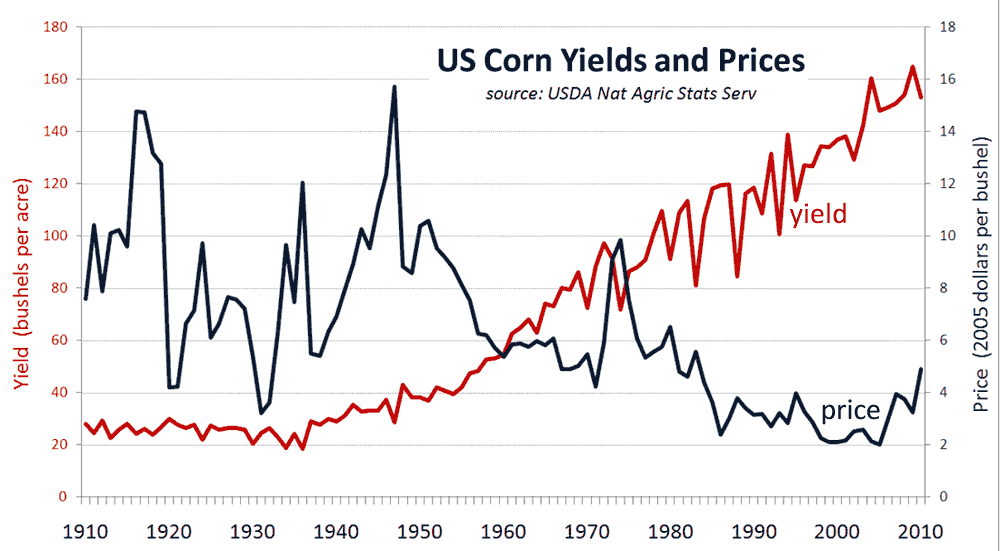
And it came to pass that corn yields (output per acre) boomed.  And that corn prices slumped.  Here’s a graph I just made; again look at what happens after 1950.

Click to see the graph. Data are from the USDA's National Agricultural Statistics Service.

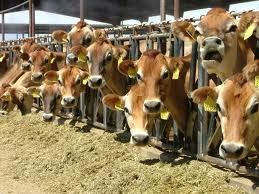
The change in grain (especially corn) ecology led to the splitting of crop and livestock production and laid the foundation for factory farming, highlighted by the hyperproduction of maize and maize-feeding cows (and other animals) in CAFO’s.

Of course cows are ridiculously inefficient at turning grain into meat.  The “feeding efficiencies” of stock animals change through time, but in 1975 when US beef consumption was at its peak, it was taking 14 kg. of corn to make 1 kg of beef.  For comparison, the ratio for pork was 6:1, and for chickens 3:1.  But that wasn’t a problem, it was an opportunity; after all, the system was in effect looking for ways to burn up the surplus corn.

Americans had eaten beef before, but the beef boom began in the 1950s — a story that has been told elsewhere.  The underlying cause was a surplus of fertilizer being turned into a surplus of grain being turned into a surplus of beef.  So when we hear that the worlds needs to boost food production by so much, not just because of population growth but because people in developing countries want to eat more meat, it’s a bit convoluted.  We eat this much beef, and have these institutions to provide it so conveniently, because we overproduce grain.

Notes.  If you’re interested in “distancing” and “fresh” foods, you owe it to yourself  to read Suzanne Freidberg’s wonderful book Fresh.  On meat eating as “progress” throughout history I recommend Warren Belasco’s Meals to Come: A history of the future of food.  A fascinating article on the politics and ecology of splitting up crop and livestock production is Foster & Magdoff’s “Liebig, Marx, and the depletion of soil fertility: relevance for today’s agriculture” in Hungry for Profit. The figures on feeding efficiencies are from Smil (2002) “Eating meat: Evolution, patterns, and consequences,” Population and Development Review 28:599-639.

Posted in Agriculture, Food | Tagged , , , , , | 2 Comments

Golden Rice, soon. Or not.

We have a new E.T.A. on Golden Rice. Well, sort of: the institutes in the Philippines that have been conducting field tests since 2008 say they may be able to submit the needed data for regulatory approval by 2013 in the Philippines and 2015 for Bangla Desh. So maybe a 2014 release in the Philippines.

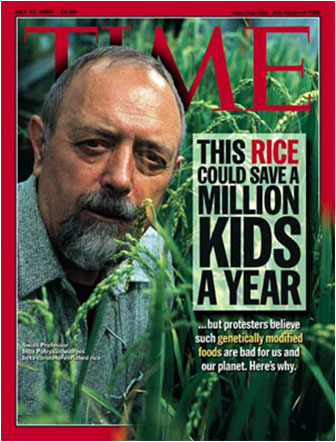
Summer, 2000.

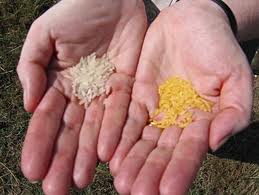
Golden Rice is genetically modified to produce beta carotene in the grain (instead of just in the bran). It was mainly funded by the Rockefeller Foundation as a possible means of mitigating vitamin A deficiency in Asia, although I think it’s fair to say that Rockefeller has soured a bit on biotech approaches to food improvement since then.

Golden Rice has been the subject of intense promotion since it appeared on the cover of Time in 2000, and many people assume it has been eaten by the poor for years. This illusion has been encouraged by the biotech industry and many others too: for instance, a leading South African biotechnologist who writes on Africa’s food needs scolded the press for “bias” in not covering how it has saved children from blindness, internationally recognized leaders in biotech have claimed Golden Rice to have already saved many lives, and US congressional documents claimed it to have saved the sight of thousands of children..

Golden Rice is still years from being released, but it’s got an even bigger problem: the big ugly M branded on its ass when it was young will cause problems for the rest of its life. It seems that the researchers initially used the 35S promoter to try to get their set of introduced genes to work. A promoter is a stretch of DNA that tells a gene when and where to express. Sometimes a promoter is referred to as a kind of gene, sometimes as a part of the gene, sometimes as something separate from the gene – the terminology isn’t standardized. But they are essential to making genes work, and the most common promoter in genetic research, hands down, is the “Cauliflower Mosaic Virus 35S” promoter — on which Monsanto happens to have a patent. (How anyone can patent naturally occurring DNA anyway? – see my earlier posting, Baseball bats and Breast Cancer.)

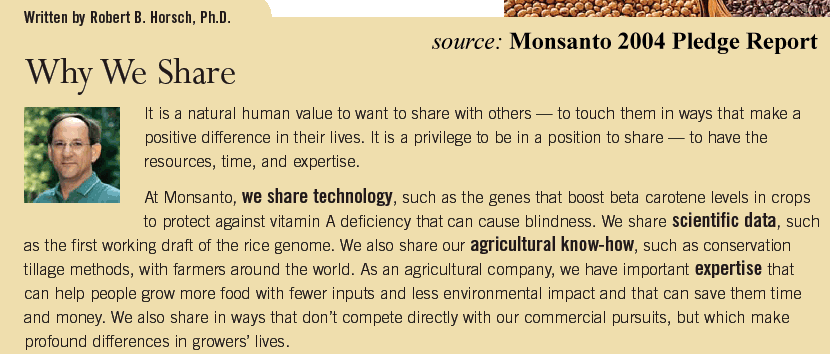
DNA patent-holders routinely let researchers use “their” DNA in experiments, but reserve the right to profit from (or block development of) commercial products. In 2000, with an enormous image problem on its hands and meanwhile with Golden Rice on the cover of Time, Monsanto agreed to forego any share of the profits from this rice. It’s doubtful they would have made any money on this crop anyway, especially since the 35S viral promoter was soon replaced with a plant promoter. But for the “altruistic” act of giving up non-existent profits on a rice for the poor, Monsanto launched a shameless PR campaign in which they essentially took credit for actually developing Golden Rice:

Check this out.

They were still crowing about Golden Rice 4 years later, after their promoter had been replaced.

If this was disheartening to Rockefeller, it was infuriating to biotech critics, who up till then had mainly picked fights with commercial products. Their attitude quickly became “If you’re going to clean up your image with Golden Rice, just watch how much mud we can put on Golden Rice.” Golden Rice was a hoax, wrote Vandana Shiva; a trojan, wrote RAFI. Ineffective, said many observers — too little beta carotene to impact health (that was true, but it has greatly improved). Anyway, said Greenpeace, “Why go to the problem of producing golden rice when you still have to eat vegetables anyway?” Some of the attacks were over the top, some had some truth, but many of them wouldn’t have been worth making if not for that big ugly M.

In short, Monsanto obstructed the successful deployment of Golden Rice.  (It would have had its detractors anyway, but falsely claiming it to be a corporate product hung a huge and unnecessary target on it.)  Monsanto probably further impeded its adoption by publicizing it as a food for the poorest of the poor.  Poor people are like everyone else: they don’t want poor people food.

No one knows how Golden Rice will be received in the Philippines. One GM crop (Bt maize) is already being grown there on a small scale but no food crops. GM crops are not a topic of intense debate there as they are in much of Europe and India.  Adoption probably won’t be decided on the basis of human health – no one’s going to eat this and suddenly get healthy. It will turn on how the presentation & debate articulate with local culture.

Many people have more or less understood this for some time. Back in 2003, the president of the Philippine Federation of Free Farmers pointed out that the success or failure of Golden Rice all depends on how it is presented to the public; “If we do it carefully and with sensitivity to the concerns of all stakeholders, I think it will be that much easier to sell the technology…But if we do it in an insensitive manner, although it has a lot of promise, it could end up exploding in our faces.”

And the presentation by its backers is only half the story; if and how anti-GMO forces elect to oppose the rice is the other half. Given how hard it will be to wash off Monsanto’s taint, and given the industry media onslaught we’ll get when it is released, the green activists just might be on it (dare I say) like white on rice.

And that’s just in the Philippines. In Bangla Desh — not to mention India, where it is also being trialed — there will be a shitstorm.

Posted in Agriculture, Biotechnology, Food, Intellectual Property | Tagged , , , , , | 2 Comments

Do Not Read: GM Cotton and Indian Farmer Suicide

More in the news this week about Indian cotton farmers killing themselves.

Mainly cotton farmers. Mostly deep in debt.

One every 30 minutes.

Bt cotton contains a gene from a bacterium that produces an insecticide against some caterpillars that are serious cotton pests. Whether you believe it is a killer or a savior in India probably depends on who you hang out with. Most of what is said on the issue spreads through highly polarized agenda-driven information networks. I have spent the last 10 years doing research among Indian cotton farmers, and if I were to say my findings showed Bt seed to be a killer, it would be picked up by the enviromentalist, liberal, crunchy, anti-corporate, and European information channels. On the other hand, if I said my findings show Bt seed to be saving Indian farmers from ruin, it would be picked up by a lavishly funded network of industry and cat’s paw websites, as well as by some highly partisan academics who have long ago left behind any pretense of scientific objectivity.

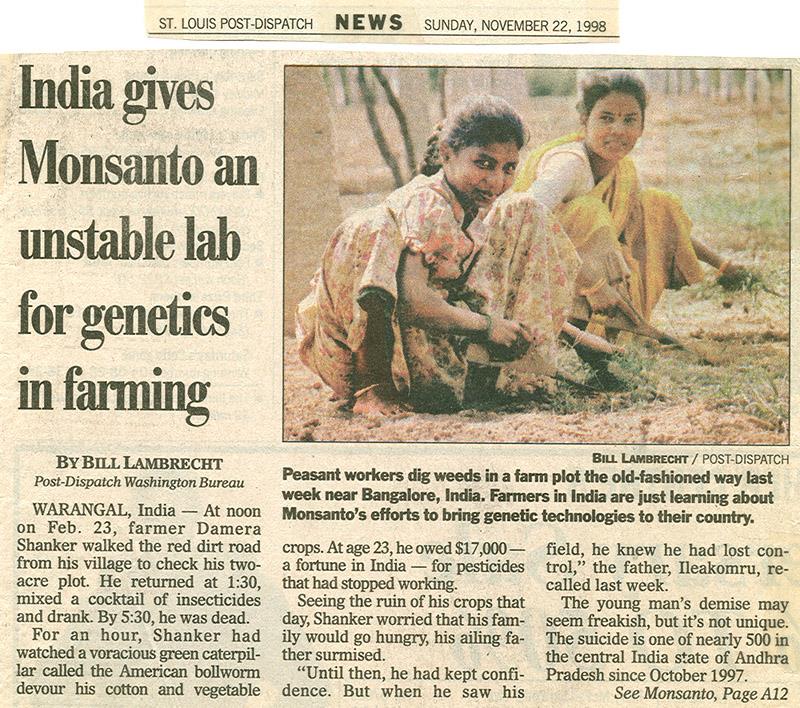
Bt cotton has been linked to suicide since before it was being planted. Four years before Bt cotton was approved, Post-Dispatch reporter Bill Lambrecht wrote about the Warangal suicides and Monsanto

Actually what I have learned about GM seeds and farmer suicide doesn’t fit either platform.

That means it’s unlikely to be propagated through either network, and you are unlikely to be reading this right now.

But if you were reading it, you would find out that both claims are false.

“GM Genocide?” Bt cotton is repeatedly said to cause farmer suicide because

  1. it is expensive, plunging poor farmers into debt
  2. it requires high levels of water
  3. it “fails” a lot (“invariably” according to the latest claims)

Let’s look at each claim.

  1. Bt cotton appeared in 2002. Before that, a box of seed cost 400 rupees (about $10.) Cotton farmers usually buy 1-3 boxes of seed. At first, Bt seed cost $40/box but they were forced to lower it; it has usually cost $19 in recent years. Some economists point out that farmers’ pesticide bill usually drops when they buy Bt seed, which I found as well. But also consider the larger context. I surveyed cotton farmers a few years ago and found the median debt to be $375. Farmers definitely feel the extra $9/box, but it’s a bit of a stretch to see this as a crippling addition to their debt.
  2. There’s nothing about Bt that makes a cotton plant need more water. In the beginning, Monsanto/Mahyco started by putting the trait into existing hybrid seeds, some of which were water-intensive. But soon there were dozens, and now hundreds, of Bt hybrids on the market, with varying water requirements.

    Adapted from G. D. Stone 2011 Field vs. Farm in Warangal: Bt Cotton, Higher Yields, and larger Questions. World Development 39(3):387-398.

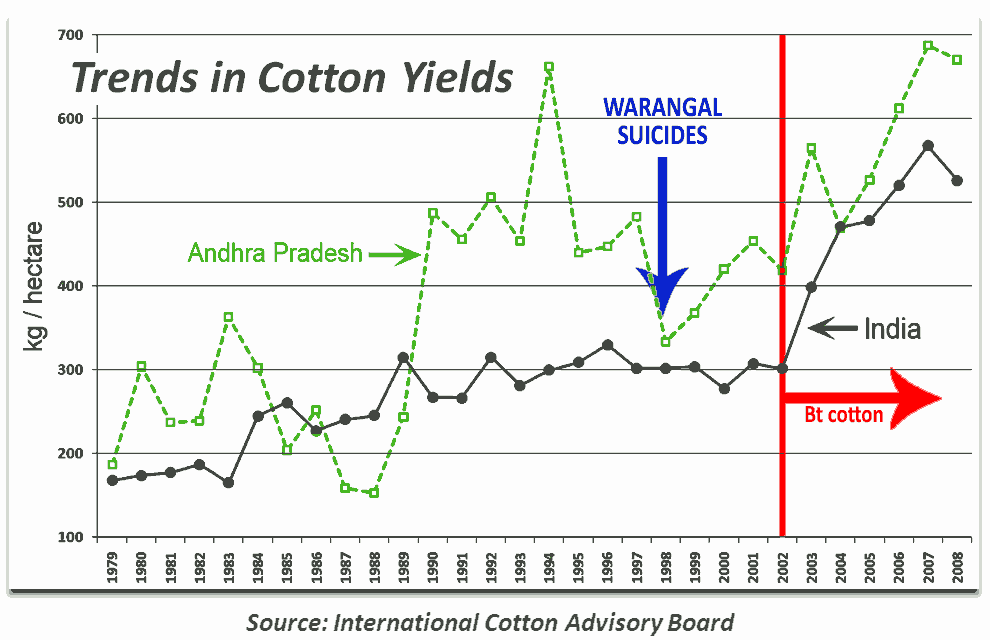
  3. Cotton productivity has never been higher in India. I studied villages across Warangal (a district in Andhra Pradesh notorious for farmer suicides): in between 2003 (when basically no one planted Bt cotton) and 2007 (when basically all cotton farmers did) yields rose 18% (see the recent World Development). And look at the chart of trends in cotton yields: tough to reconcile with the claim that Bt cotton “invariably fails.”

Moreover, the timing of the suicides and the Bt cotton just don’t work. The worst rash of suicides was in Warangal in 1998 — 4 years before Bt seed was even on the market. The trends in suicide and Bt cotton adoption don’t match at all (as shown in a well researched and balanced report by the International Food Policy Research Institute.)

GM is a savior? There are some serious problems with the economics studies of Bt cotton and that’s a whole other story. But there is also a lot going on in recent cotton history other than ‘Bt or not Bt.”

Look at the AP line in the chart and consider that Bt cotton wasn’t even adopted on a significant scale until 2005. There’s a ten year surge in cotton yields, and six years of it happened before Bt started to spread. Ag hands can ponder the various factors affecting these trends, but one thing is for sure: most of the cotton boom cannot be attributed to Bt seed.

In fact Bt seed also appears to be exacerbating a key problem underlying the suicides: technology treadmills.

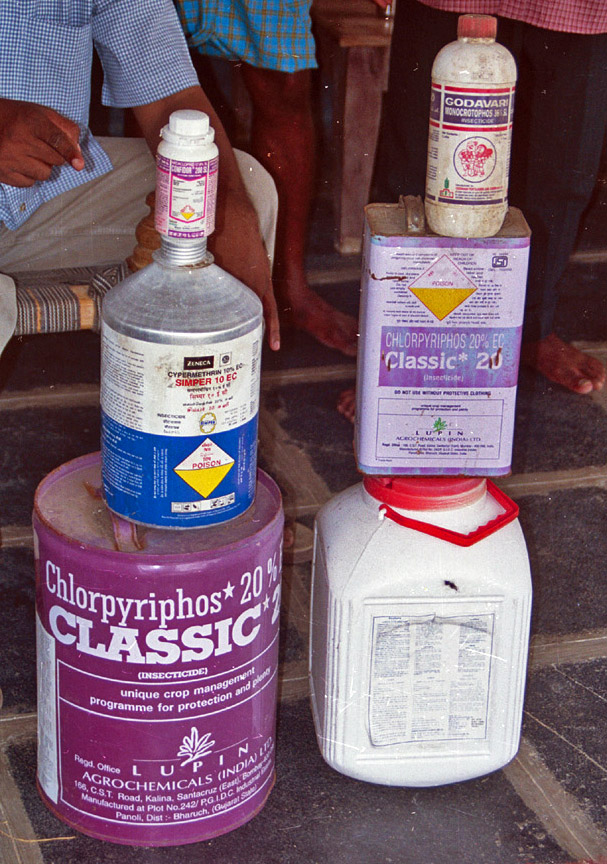
Technology treadmills can have disastrous effects on farm management. I saw how badly farmers were trapped on the pesticide treadmill the first time set foot in Warangal in 2000: they kept asking me if I had, or knew of, a “new pesticide” because the insects had developed resistance to the last pesticide. In a bit of gallows humor, a group of farmers built a mountain of empty cans from the pesticides they had gone through (including chlorpyrifos, subject of a previous blog).

Even worse was the “seeds treadmill,” with literally hundreds of hybrid seed brands appearing and disappearing on the stores, and the normal process of farmer evaluation breaking down.

The seed and spray treadmills are slightly different, but both have viscious effects on local ecology, on farm economy, and on the farmer decision-making. And then, for a coup de grâce, they destroy the farmer’s confidence that he’ll ever dig his way out.

Farms always have bugs; farmers always have debts. What is different about Indian cotton farming is this treadmill. (It’s not a problem with rice, which is the biggest crop in the area. Cotton farmers grow rice too but they hardly ever say it was their rice field that drove them to suicide. New rice varieties appear at a moderate pace that allows farmers to evaluate them.)

Bt cotton has been generally effective in warding off caterpillars. It has not “failed” and has not run up farmer debts, no matter what the network of anti-GMO sources say. But it has now snagged farmers on a genetic technology treadmill. By 2009 there were 5 different Bt gene combinations going into 284 separate Bt hybrids. Before anyone figures out how these seeds function, they will be replaced. Now populations of the non-target pests are starting to explode, and biotech companies are working on new genes as a solution for that problem.

But for Indian cotton farmers, the “solution” is the problem.

Posted in Agriculture, Biotechnology, India | Tagged , , , , , | 5 Comments

10 Billion People and Paul Ehrlich’s Taxi

When the U.N. announced its global population projection of 10 billion by 2010 a few days ago, it was hard not to think back on Paul Ehrlich.  Prof. Ehrlich was the butterfly researcher whose books and TV appearances scared the bejeezus out of us in the late 60s with predictions of a planet running out of food and hundreds of millions starving.  Ehrlich’s name has come up as pundits have been pondering the meaning of this scary projection, but actually he and wife Anne had already taken a victory lap in HuffPo  a few weeks earlier:

When The Population Bomb was published in 1968, there were 3.5 billion people, and we were called alarmist — technology could feed, house, clothe, educate, and provide great lives to even 5 billion people. Nuclear agro-industrial complexes or growing algae on sewage would feed everyone. Well, they didn’t. Instead, the roughly half-billion hungry people then have increased to about a billion…

The fear of runaway population, and the belief that it explains hunger, are old indeed; they even predate Malthus.  But in modern times no one has beat these drums as loudly as Ehrlich.  With this new population projection reviving old concerns, it’s a good time to think about Ehrlich’s victory lap and whether he has earned it.

Ehrlich’s original population epiphany was triggered by a wild ride in a Delhi taxi which he described in the prologue to The Population Bomb:

Indian cities are crowded alright. But then again, they are cities.

I have understood the population explosion intellectually for a long time. I came to understand it emotionally one stinking hot night in Delhi a few years ago. My wife and daughter and I were returning to our hotel in an ancient taxi. The seats were hopping with fleas. The only functional gear was third. As we crawled through the city, we entered a crowded slum area. The temperature was well over 100, and the air was a haze of dust and smoke. The streets seemed alive with people. People eating, people washing, people sleeping. People visiting, arguing, and screaming. People thrusting their hands through the taxi window, begging. People defecating and urinating. People clinging to buses. People herding animals. People, people, people, people. As we moved slowly through the mob, hand horn squawking, the dust, noise, heat and cooking fires gave the scene a hellish aspect. Would we ever get to our hotel? All three of us were, frankly, frightened… since that night I’ve known the feel of overpopulation.

The problem, he concluded, was bigger than the crowded evening hell in Delhi: it was that there could never be enough food for all those Indians.  In 1968 he wrote

The battle to feed all of humanity is over.  In the 1970s and 1980s hundreds of millions of people will starve to death in spite of any crash programs embarked upon now.

The next year he was more specific, writing that “by 1985 enough millions will have died to reduce the earth’s population to some acceptable level, like 1.5 billion people.”  More chilling yet: “[m]ost of the people who are going to die in the greatest cataclysm in the history of man have already been born”; by 1975, “some experts feel that food shortages will have escalated the present level of world hunger and starvation into famines of unbelievable proportions.”

Oddly enough, Ehrlich was saying all this just as wheat yields were soaring due to Green Revolution seeds.  In fact, this “revolution” was never the life saver that it is in legend; I am persuaded by the analysts who say that it mainly led to the replacement of cut-rate American wheat with Indian-grown wheat.  But while I’m thinking that India wouldn’t have starved even without the Green Revolution, Ehrlich was sure India would starve even with it.  The statistics said there as plenty of food but Ehrlich was having none of it:

These clowns who are talking of feeding a big population in the year 2000 from make-believe ‘green revolutions’ … should learn some elementary biology, meteorology, agricultural economics and anthropology…

Trends in per capita Agricultural Production Index Number. Data from FAO.

I know some elementary anthropology and I have to point out that Ehrlich’s claims about population and agriculture have never fit the facts.  Farm production per capita was climbing in the 1960s, it has been climbing ever since, and the FAO sees it continuing to climb for as far out as they care to project (2030).  India does have a lot of undernourished people, but it has nothing to do with population ourstripping farm production; in fact as I pointed out recently, India has an ongoing crisis of grain surpluses.

OK, but just because Ehrlich has been wrong for the last 40 years, doesn’t this scary new projection warrant pulling the alarm?  What’s the harm in trying to be safe rather than sorry?

Actually there is a lot of harm.

First, these projections are much too fuzzy to base anything on.  To quote Joel Cohen (who, unlike most commentators, actually knows a lot about population), tiny changes in our assumptions about reproduction give wildly different numbers.  If women average just half a child more or half a child less than the U.N. assumes, the population in 2100 rises to 15.8 billion or falls to 6.2 billion, which was the world’s population around 2001.  The farther into the future you project, the more you are just guessing.  We have no theory to predict the reproductive behavior of people who have not even been born yet.

But more importantly, attributing hunger to population growth distracts attention from the actual (primarily political) causes of hunger while yielding the floor to the politicians, academic researchers and corporations that benefit by promoting agricultural inputs.  After all, if we really are in a desperate scramble to create food, then all these discussions about sustainable, organic, local, and humane farming are a dangerous distraction.

On the other hand, if we are making ourselves and our environment sick with agricultural systems that grow faster than the population, then it is writing like Ehrlich’s that is the dangerous distraction.

Posted in Agriculture, Food | Tagged | 5 Comments